Showing posts with label Sources. Show all posts

Sunday, August 6, 2023

Clarke (1)

Here are some fables from H. Clarke's Latin textbook Fabulae Aesopi selectae, or, Select fables of Aesop, and you can click here for all the fables reposted from this book at the blog. I plan to do a LibriVox recording of this book, so I will be transcribing all the fables here, and later I will be able to embed the LibriVox audio.


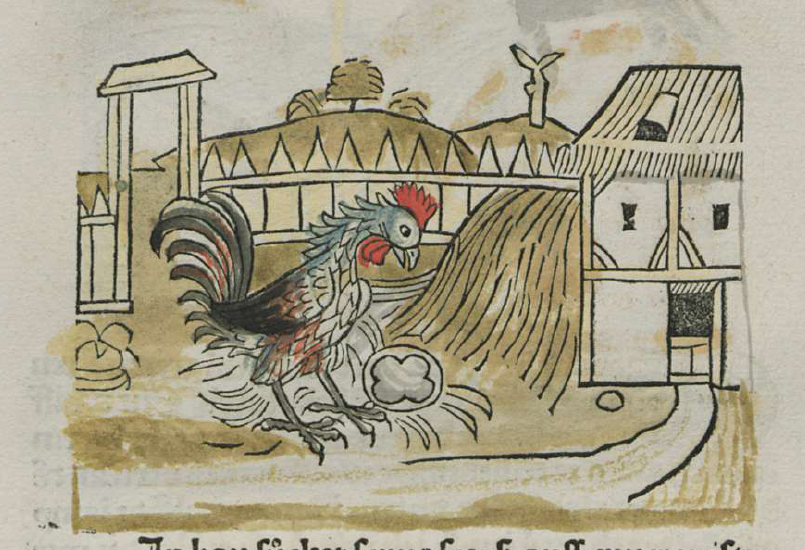
1. Of the Cock
A Cock, while he turns up a dunghill, finds a jewel, saying, why do I find a thing so bright? If a jeweller had found thee, nothing would be more joyful than he, as who would know the price: indeed it is of no use to me, nor do I esteem it at a great rate; nay indeed I had rather have a grain of barley than all jewels.
The Moral. Understand by the jewel, art and wisdom; by the cock, a man foolish and voluptuous; neither fools love liberal arts, when they know not the use of them; nor a voluptuous man, because pleasure alone pleases him.


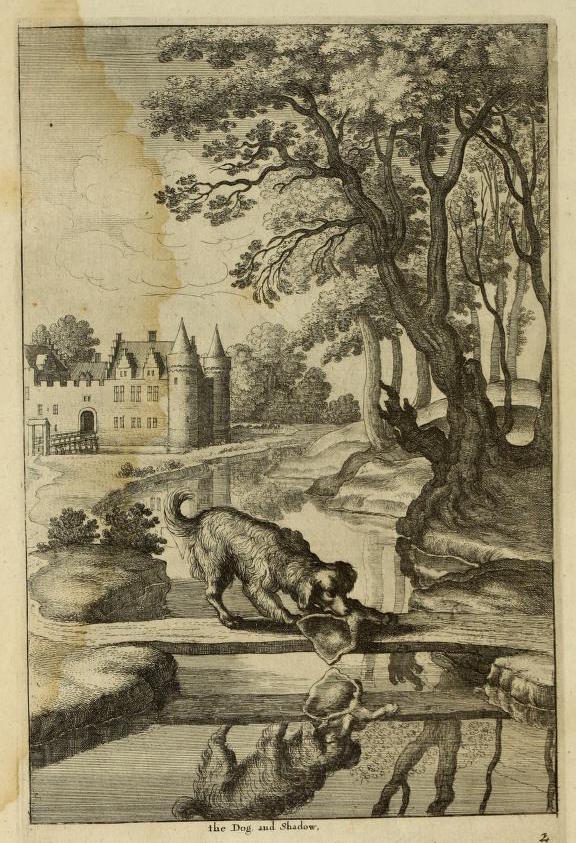
2. Of the Dog and the Shadow
A dog swimming over a river carried flesh in his chops; the sun shining, the shadow of the flesh shone in the waters; which he, seeing and greedily catching at, lost what was in his jaws: therefore struck with the loss both of the thing and his hope, at first he was amazed; afterwards, taking courage, thus he barked out: wretch! moderation was wanting to thy desire: there was enough, and too much, unless thou hadst been mad. Now, through thy folly, there is less than nothing for thee.
Moral. Let there be moderation to thy desire, lest thou lose certain things for uncertain.


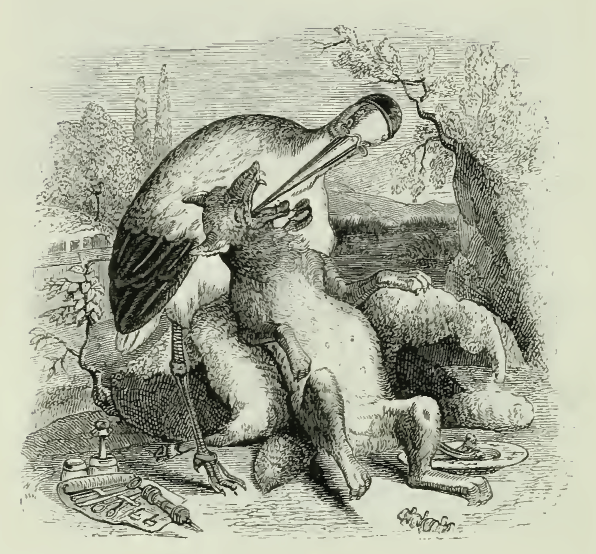
3. Of the Wolf and the Crane
While a wolf devoureth a sheep, by chance the bones stuck in his throat; he goes about, asks help, nobody assists; all say that he had got the reward of his greediness: at length, with many flatteries and more promises, he draws in the crane, that her very long neck being thrust into his throat, she would pull out the bone fixed in. But he played upon her asking a reward, saying, fool, go away! hast thou not enough, that thou livest? Thou owest thy life to me; if I would, I was able to bite off thy neck.
Moral. What thou doest for the ungrateful, perisheth.


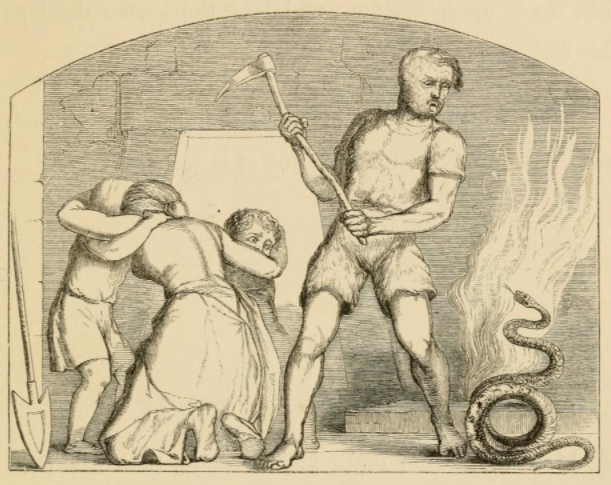
4. Of the Countryman and the Snake
A countryman brought home a snake found in the snow, almost dead with cold; he lays him to the fire; the snake, recovering strength and poison, then not bearing the flame, filled all the cottage with hissing. The countryman, snatching a stake, runs up, and expostulates the injury with him in words and blows, whether he would return these thanks? Whether he would take life from him, who had given life to him?
Moral. Sometimes it happens that they are hurtful to thee, whom thou hast profited; and they deserve ill of thee, of whom thou hast deserved well.


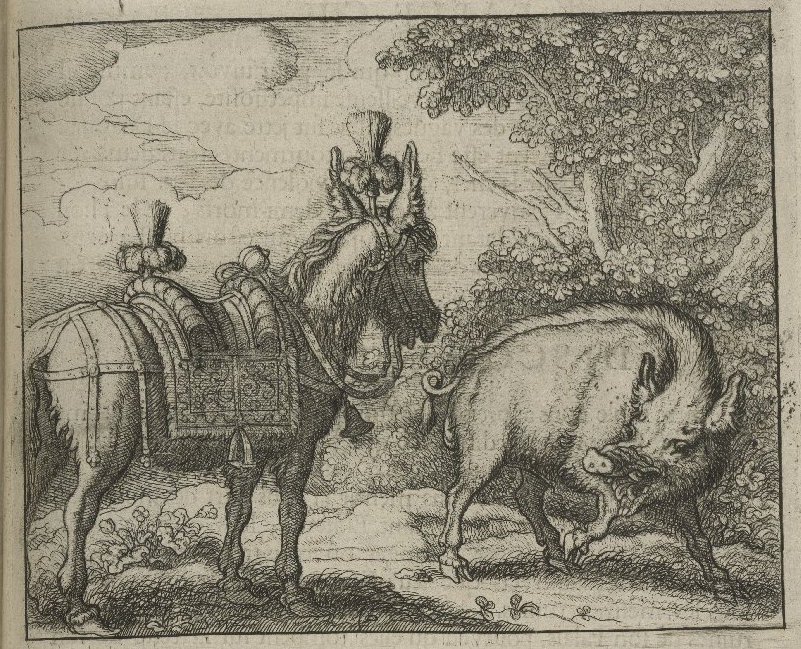
5. Of the Boar and the Ass
While the sluggish ass laughed at the boar, he, fretting, gnashed his teeth. Most slothful wretch, thou hast indeed deserved evil; but although thou hast been worthy of punishment, yet I am unfit who may punish thee. Laugh secure, for thou art safe for thy sluggishness.
Moral. Let us give an endeavour, that when we hear or endure things unworthy of us, we do not say or do things unworthy of us. For bad and lost men generally rejoice, if any one of the good resist them; they value it at a great rate that they are accounted worthy of revenge. Let us imitate horses and great beasts who pass by barking curs with contempt.


Monday, July 24, 2023

Cole (1)

This book of fables bears an impressive title: Select Tales and Fables With Prudential Maxims and Other Little Lessons of Morality in Prose and Verse Equally Instructive and Entertaining for the Use of Both Sexes, published in 1780 with engravings by B. Cole, whom I assume is Benjamin Cole (1697-1783; more information at the British Museum). I used the better scan at Hathi Trust for snagging the illustrations.


The Bull and the Mastiff
A Mastiff (train'd to hostile Deeds)
Seiz'd a young Bull. The Monarch bleeds,
And roars aloud: Suspend the War;
Nor dare to urge my Rage too far.
Thy Rage, he answer'd, I defy;
I'm bred to conquer or to die.
Thy Folly then be on thy Head,
The Monarch cry'd, and struck him dead.
As Education rules our Will,
Our future Fortune's good or ill.


The Elephant and the Bookseller
An Elephant, in Days of Yore,
(So Pliny says) on Books would pore,
Visit the Shops, learn'd Volumes spread,
And make Remarks on what he read.
A Bookseller, who heard him speak
And with just Accent mouthe the Greek,
Addrest him thus: Exert your Skill
Against Mankind, I'll pay you well.
No, Sir, Let Man commence the Fray;
Envy's a sharper Spur than Pay.


The Wolf and the Lamb
As once a Wolf his Thirst allay'd
At a cool Spring, a Lamb essay'd
To taste at Distance of the Stream;
Nor thought it would Presumption seem.
But Isgrim with Resentment said,
Who's that disturbs the Fountain-head?
In vain the Lamb NOT GUILTY pleads,
And Right or Wrong that Instant bleeds.
Thus Tyrants keep the World in Awe:
Their boundless Will is all their Law.


The Fox and the Mask
The Fox an Actor's Vizard found,
And peer'd and felt, and turn'd it round;
Then threw it in Contempt away,
And thus old Phaedrus heard him say:
What noble Part can thou sustain,
Thou spurious Head, without a Brain?


The Daw and the Peacocks
A Daw, in pilfer'd Plumes array'd,
Imagin'd she a Figure made;
With Affectation toss'd her Head,
And straightway to the Peacocks fled:
But there th'Impostor play'd her Part,
So vainly, with so little Art,
That soon the Birds, with high Disdain,
Stripp'd her, and sent her Home again.
Thus when a Coxcomb apes the Great,
Derision and Contempt's his Fate.


Saturday, July 22, 2023

Bourne (1)

William Bourne's book Gems from Fable-land, subtitled "a collection of fables illustrated by facts," is a combination of Aesop's fables and historical anecdotes (some of the anecdotes more historical than others). I've selected both fables and anecdotes from this book to include here at the blog. This use of historical anecdotes fits in with the traditional Aesop, as Phaedrus included anecdotes about the Roman imperial family in his collection of fables (the most ancient extant collection).


DIOGENES EXPOSING PRIDE
Diogenes, being at Olympia, saw at that celebrated festival some young men of Rhodes, magnificently dressed. Smiling, he exclaimed, "This is pride." Afterwards meeting some Lacedemonians, who were in a mean and sordid dress, he said, "This also is pride." 
The keen observation of the philosopher enabled him to detect pride in these two opposite exhibitions of human nature.


THE PHILOSOPHER OUTDONE
A learned philosopher being in his study, a little girl came for some fire. The doctor said, "But you have nothing to take it in," and as he was going to fetch something, the girl, taking some cold ashes in one hand, put the live coals on with the other.
The astonished sage threw down his books, saying, "With all my learning I never should have found out that expedient."


THE BROOK AND THE FOUNTAIN
   A Fountain varied gambols played,
Close by an humble brook;
While gently murmuring thro' the glade.
Its peaceful course it took.
   Perhaps it gave one envious gaze
Upon the Fountain's height,
While glittering in the morning rays,
Pre-eminently bright.
   In all the colours of the sky,
Alternately it shone:
The Brook observed it with a sigh,
But quietly roll'd on.
   The owner of the Fountain died;
Neglect soon brought decay;
The bursting pipes were ill supplied;
The Fountain ceased to play.
   But still the Brook its peaceful course
Continued to pursue;
Her ample, inexhausted source,
From Nature's fount she drew.
   "Now," said the Brook, "I bless my fate
My showy rival gone;
Contented in its native state
My little stream rolls on.
   And all the world has cause, indeed,
To own, with grateful heart,
How much great Nature's works excel
The feeble works of art."
Moral. Humble usefulness is preferable to idle splendour.
                                    (from the Polish fables of Krasicki)


THE ST. PETERSBURGH MISER
A Russian merchant, who was so immensely rich, that on one occasion he lent the Empress Catharine II a million of rubles, used to live in a small obscure room in St. Petersburgh, with scarcely any fire, furniture, or attendants, though his house was larger than many palaces. He buried his money in casks in the cellar, and was so great a miser, that he barely allowed himself the common necessaries of life. 
He placed his principal security in a large dog of singular fierceness, which used to protect the premises by barking nearly the whole of the night.
At length the dog died; when the master, either impelled by his avarice from buying another dog, or fearing that he might not meet with one that he could so well depend on, adopted the singular method of performing the canine service himself, by going his rounds every evening, and barking as well and as loud as he could, in imitation of his faithful sentinel.  


THE MOUSE AND THE ELEPHANT
A pert young Mouse, but just arriv'd
From Athens, where some time he'd liv'd;
And daily to the portico,
To pick up learning, used to go;
Vain of the wisdom he had stor'd,
And of the books he had devour'd;
Puff'd up with pride, and self-conceit,
And proud to show his little wit,
Thus to an Elephant, one day,
He took it in his head to say,
"Nay, not so pompous in your gait,
Because Dame Nature made you great;
I tell you, sir, your mighty size
Is of no value in my eyes;
Your magnitude, I have a notion,
Is quite unfit for locomotion;
When journeying far, you often prove
How sluggishly your feet can move.
Now, look at me: I'm made to fly:
Behold, with what rapidity
I skip about, from place to place,
And still unwearied with the race;
But you, how lazily you creep,
And stop to breathe at every step!
Whenever I your bulk survey,
I pity—" What he meant to say,
Or with what kind of peroration
He'd have concluded his oration,
I cannot tell; for, all at once,
There pounc'd upon the learned dunce
An ambush'd Cat; who, very soon,
Experimentally, made known,
That between Mice and Elephants
There is a mighty difference.
MORAL.
When fools pretend to wit and sense,
And wish to shine at your expense,
Defy them to the proof, and you
Will make them their own folly shew.
     (from the Italian fables of Pignotti.)


Thursday, July 20, 2023

Bussey (1)

One of the most monumental collections of fables is this book by G. Moir Bussey: Fables, Original and Selected, and, as the subtitle explains, these are fables "by the most esteemed European and Oriental authors." There are 575 fables here, making it the next biggest English Aesop that I've found (the biggest English  Aesop so far, I'm proud to say, is still my Oxford World's Classics book, which has 600 fables). Of course, by the time I finish this project, I'll have an Aesop with thousands of fables in English.

Here are some fables transcribed from Bussey:


THE FALCON AND THE HEN
Different circumstances make the same action right or wrong, a virtue or a vice. 
"Of all the creatures I ever knew," said a falcon to a hen, "you are certainly the most ungrateful."
"What instance of ingratitude," replied the hen, "can you justly charge upon me?"
"The greatest," returned the falcon; "ingratitude to your highest benefactors, men. Do they not feed you every day, and shelter you every night? Nevertheless, when they endeavour to court you to them, you ungratefully forget all their kindness, and fly from them as from an enemy. Now I, who am wild by nature, and no way obliged to them; yet upon the least of their caresses, I suffer myself to be taken, and go or come at their command." 
"All this is very true," replied the hen, "but there may be sufficient reason both for my fear and your familiarity: I believe you never saw a single falcon roasting at the fire; whereas, I have seen a hundred hens trussed for that purpose."


THE WOLF AND THE SHEPHERD
A shepherd lost the whole of his flock by a dreadful contagion. The wolf, hearing of it, came to condole with him. 
"Shepherd," said he, "is it true that thou hast met with so severe a misfortune, and art deprived of thy whole flock? So amiable, pious a flock! I feel for thee, and could shed tears of blood." 
"Many thanks, master Wolf;" said the shepherd. "I see thou hast a heart brimful of compassion." 
"Indeed, he has," added the shepherd's dog, "wherever he suffers in person by his neighbour's misfortune."


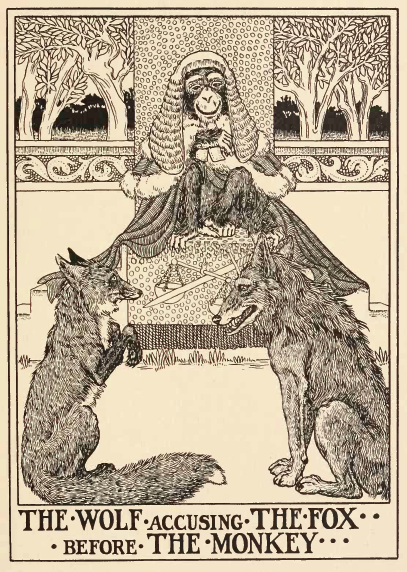
THE WOLF, THE FOX, AND THE APE
A wolf one day demanded judgment against a neighbouring fox, for larceny. The cause was argued in the court of Mr. Justice Ape by the parties in person; and, as may be judged from their characters, though no lawyers were employed, the question was one of the most entangled and intricate that had ever been brought before the bench for decision.
When the litigants had exhausted both themselves and their arguments, the Judge, well acquainted with the knavery of each, pronounced sentence as follows: 
"My friends, I have known you both for some time; and, wishing to temper justice with mercy, shall inflict on each an equal penalty. On you, Mr. Wolf, because you complain without having sustained any injury, and on you, Renard, as without doubt you have committed the theft you are accused of."
The ape dismissed the court with this profound remark, that "Whether right or wrong, there could be no injustice in punishing rogues."


THE NIGHTINGALE AND THE PEACOCK
A sociable nightingale found amongst the songsters of the grove, plenty who envied her, but no friend. "Perhaps," thought she, "I may find one in another species," and flew confidingly to the peacock. 
"Beautiful peacock! I admire thee."
"And I thee, lovely nightingale!"
"Then let us be friends," continued the nightingale; "we shall not be envious of each other; thou art as pleasing to the eye as I to the ear."
The nightingale and the peacock became friends.


JUPITER AND THE HORSE
"Father of man and beast," said the horse, approaching the throne or Jupiter, "it is said that I am one of the noblest of the creations with which you have adorned the world, and my vanity bids me believe it. But do you not think my form still capable of improvement?"
"And what dost thou suppose would improve thee? Speak; I am open to instruction," said the gracious deity, smiling. 
"Perhaps," continued the horse, "I should have more speed if my legs were longer and more slender; a long swan-like neck would add to my beauty; a broader chest would increase my strength; and, once for all, since you have destined me to carry your favourite, man, it might be as well if the saddle, which the benevolent horseman supplies me with, were a part of my being. 
"Good," pursued Jupiter; "have patience a moment!" and, with a solemn air, the God spake the word of creation. The dust became animated, organized matter was combinedm and suddenly stood before the throne, the frightful CAMEL. 
The horse saw, shuddered, and trembled from excessive disgust. 
"Here are longer and more slender legs," said Jove; "here is a long swan-like neck; a broader chest; a ready created saddle! Dost thou desire to be endowed with a similar form?" 
The horse still trembled. "Go," continued the deity, "and this time the admonition shall suffice without the addition of punishment. To remind thee occasionally, however, of thy audacity, this new creation shall continue to exist!" Then, casting a sustaining glance upon the camel, Jove continued, "and the horse shall never perceive thee without fear and trembling."


Thursday, July 13, 2023

Bennett (1)

Here are some fables from Charles H. Bennett's book The Fables of Aesop and Others Translated Into Human Nature, which is most remarkable for its illustrations, also by Bennett. You can find the book at the Internet Archive, and there is also an edition with colored illustrations at Hathi Trust.


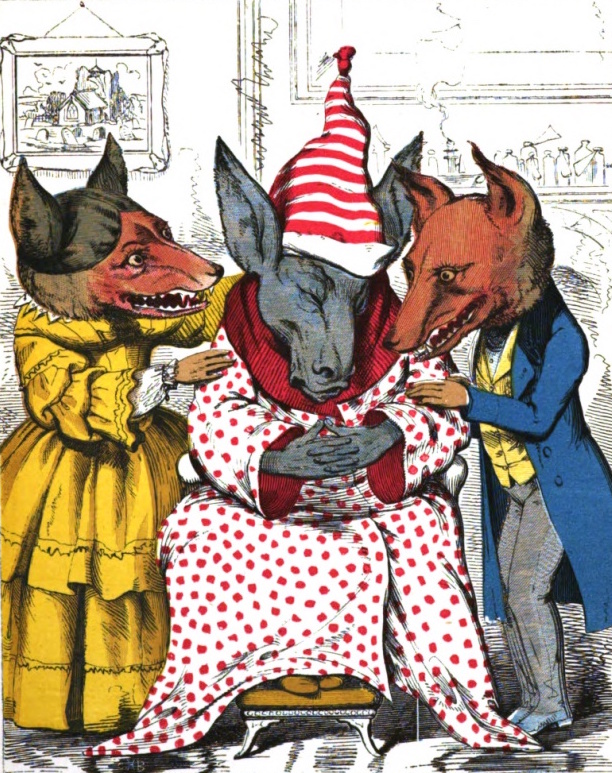
THE WOLVES AND THE SICK ASS
These were certain hungry carrion-hunting Wolves, who, in a qualm of wonderful charity, paid a visit to a fat old Ass, who lay ill of a bean-surfeit, and was like to die.
"Pray, my good friend," said they, after many protestations of regard, "whereabouts is your greatest pain?"
"Oh, gently! gently!" replied the Ass, as they proceeded to feel his pulse, "for it pricks me just there, where you lay your fingers."
MORAL. The kindness of a legacy-hunter is apt to be killing. 


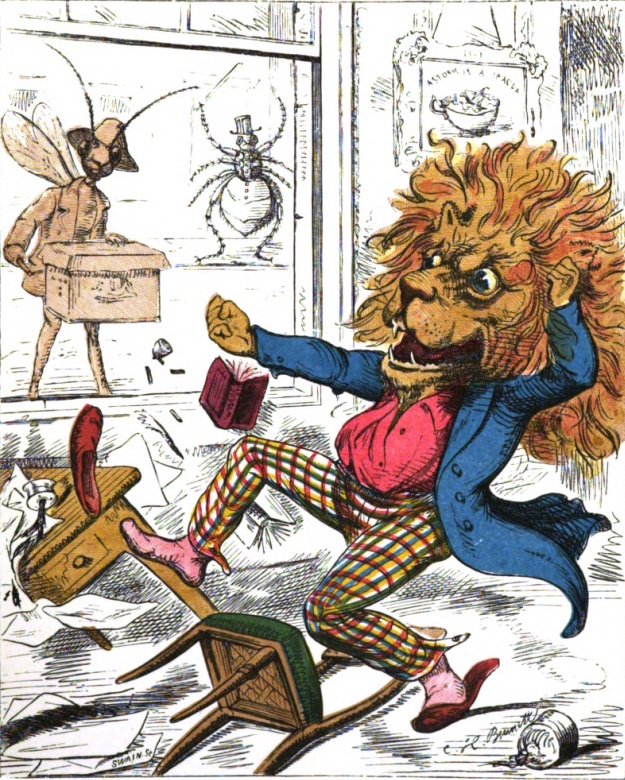
THE LION AND THE GNAT
As a great majestic Lion was gathering himself up within his lair, to astonish mankind with the wondrous powers of his roar, there came buzzing under his very nose a troublesome Gnat, who challenged him to combat.
"What avail your tremendous lungs and cavernous throat, compared to the melodious pipes of my little organ? And, as for your strength, endurance, and resolution, I defy you to put that point to an issue at once."
The Lion, finding the insect would not be brushed away, was fain to accept the challenge; so to it they went. But the Lion had no chance, for the Gnat charged direct into the drum of the Lion's ear, and there twinged him until in very despair he tore himself with his own paws. In the end the Gnat gained the victory over the noble beast, upon which he flew away, but had the misfortune afterwards in his flight to strike into a Cobweb, where he, the conqueror, fell a prey to a large Blue-bottle Spider.
MORAL. Little miseries are the greatest torments. 


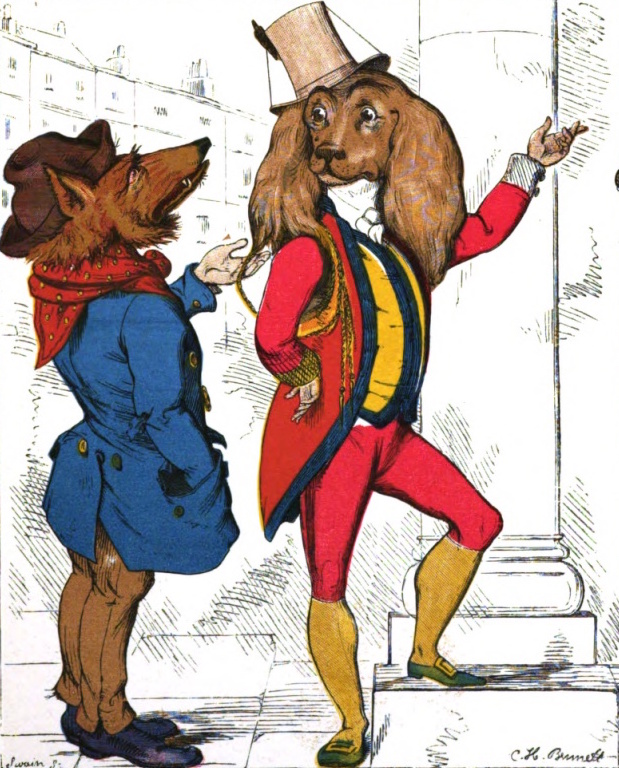
THE DOG AND THE WOLF
There was a gaunt, ragged, gipsy of a Wolf who fell into company with a sleek jolly Dog belonging to the spaniel tribe, on the King's highway. The Wolf was wonderfully pleased with his companion, and was inquisitive to learn how he had brought himself to that commendable state of body.
"Why," said the Dog, "I keep my Master's house, and I have the best of meat, drink, and lodging for my pains; indeed, if you'll go along with me, and do as I do, you may fare as I fare."
The Wolf readily agreed, and so away they trotted together; but as they approached the house the Wolf caught sight of the Dog's curiously embroidered collar, from which a kind of gold chain hung down over the shoulder. "Brother," said he, "what is this I see?"
"Oh, that's nothing," says the Spaniel; "a mere social Badge to let the world know whose Dog I am."
"Indeed!" says the other. "If those be the conditions, good bye. Bare bones and independence, rather than cold chicken with a chain and dog-collar."
MORAL. To the independent spirit, gold fetters are as galling as iron ones. 


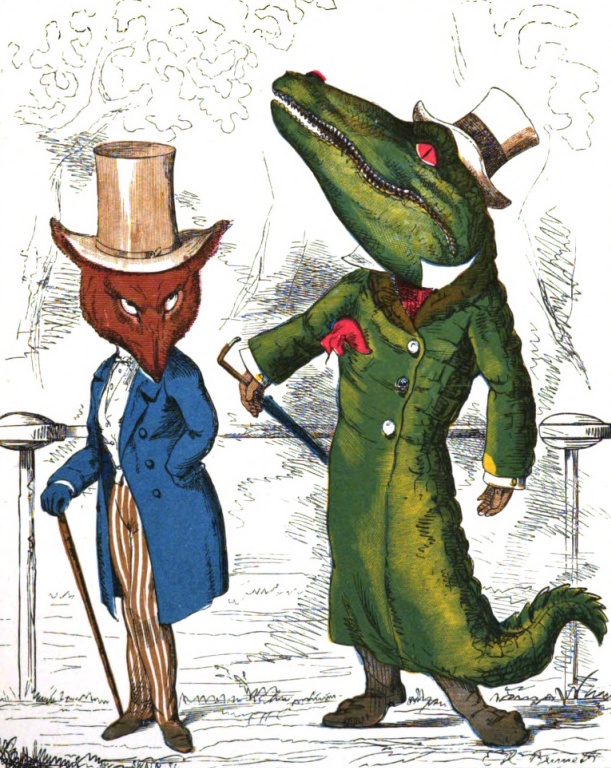
THE FOX AND THE CROCODILE
There happened to be an argument once between a quiet cynic of a Fox and a conceited vulgar Crocodile upon the point of Blood and Extraction; the Crocodile boasted of his descent and the renown of his Ancestors.
"Our family," said he, "is of the greatest antiquity. We were princes in Egypt before the foundation of the Pyramids."
"Friend," said the Fox, smiling, and pointing with his claw to certain dabs of mud resting between the coarse excrescences of the speaker's hide, "there will need no herald to prove your gentility, for you carry the marks of your origin on your very skin."
MORAL. No difgrace can arife from a humble origin but the tolly of denying it.


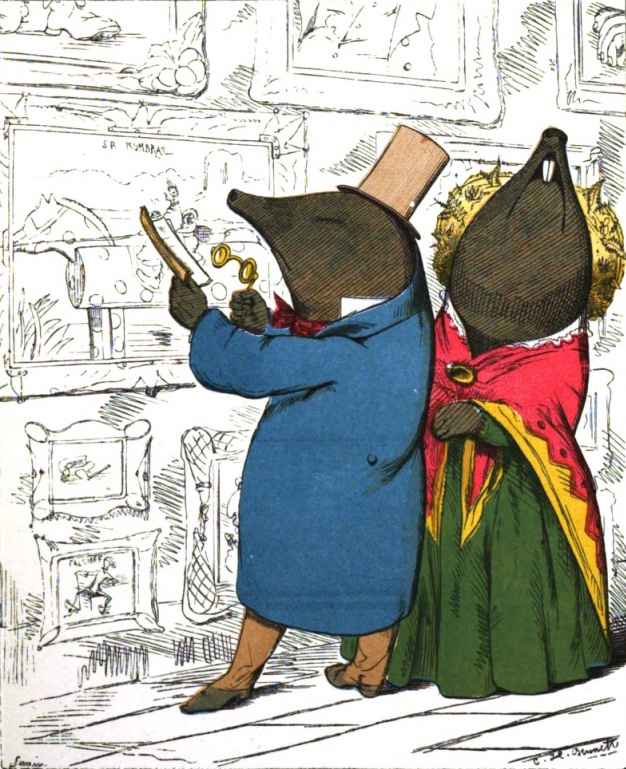
THE MOLE AND HER SON
A young conceited Mole one day prevailed upon his mother to take him out of their dwelling-hole to see some of the fine sights so much admired by the people above them. He proceeded to criticise the surrounding beauties.
"What an execrable view this is," said he, pausing in sight of a beautiful landscape, and twirling his scanty whiskers with an air. "You don't mean to tell me that sky is blue! And the idea of purple grass is positively ridiculous. There's a horse, too, with six legs, and a man taller than his own house. And I'm sure we ought to be able to see the flowers growing on those mountains at this distance! Out of all reason, colour, and proportion. Preposterous!"
"My son, my son," said the mother, "as you are incapable of appreciating what you affect to despise, it is unfortunate that you are not dumb as well as blind, and so might have escaped this exposure of your ignorance."
MORAL. The fool's tongue is like the rattlesnake's alarum, the providential sign by which we may avoid him.


Thursday, July 6, 2023

Jonathan Birch (1)

Here are some stories from Jonathan Birch's 51 Original Fables, published in 1833, with illustrations by Robert Cruikshank. You can find out more about Jonathan Birch at Wikipedia. He is best known as a translator from German, and he also did an emblem book, also illustrated by Cruikshank.


The Palfrey and the Old Horse
A pampered Palfrey, not having been saddled for many days, was turned into the yard for exercise, but finding the gate ajar he got on to the highway, and strayed about until he came to the village-pound, in which was confined an old half-starved Horse; the latter earnestly besought him to step back to his abode of plenty and fetch him a mouthful of hay, alleging that the pound-keeper had neglected to bring him his scanty pittance of provender for two days. 
"Not I!" said the Palfiey. "You but receive the just reward of your thievery and trespassing. It would be abetting you in your crimes were I to do as you wish; besides it would be robbing my mistress! I'd have you to know, Sirrah, that I am scrupulously honest."
"Alas!" replied the old worn-out Stager; "to reprimand is easy; and it is but too common to be haughty in affluence, and vain of untried virtues; you have never felt the pangs of hunger!"


The Bee, the Spider, and the Tomtit 
A Tomtit, who had listened for some considerable time to a conversation between a Spider and a Bee, relative to the skill and mathematical knowledge displayed in the construction of their web and comb, fancied he could take a part, in equally erudite terms: so down he flew, thinking to silence and astonish them by discussing the superior merits of his nest. "I have overheard you," said he, "disputing a length of time about the lines and proportions of your worthless webs and combs, without so much as once mentioning my inimitable habitation. What are they when compared with the delicate skill, just assortment of material, and glowing warmth displayed in the fabrication of my nest? There you have Mathematics, if you please!"
The Spider and Bee stared with astonishment, and at length burst very unceremoniously into a laugh, which so nettled the Tomtit that he quickly took to his tree again.   


The Monkey and the Wasp 
A Monkey, whilst munching a ripe pear, was pestered by the bare-faced importunities of a Wasp, who, nolens volens, would have a part. After threatening the Monkey with his anger if he further hesitated to submit to his demand, he settled on the fruit; but was as soon knocked off by the Monkey. 
The irritable Wasp now had recourse to invective, and, after using the most insulting language (which the other calmly listened to), he so worked himself up into violent passion that, losing all consideration of the penalty, he flew to the face of the Monkey, and stung him with such rage that he was unable to extricate his weapon, and was compelled to tear himself away, leaving it in the wound thus entailing on himself a lingering death, accompanied by pains much greater than those he had inflicted.


The Stork and Jupiter
A young stork, who was bearing his aged sire to a distant wilderness, espied a company of sportsmen dispersed over the field in search of game; too fatigued to soar to any height, he preferred a hasty prayer to Jupiter, that "in the execution of his filial duties, he would shield them from harm!" 
Jupiter instantaneously commanded a thick cloud to envelop them until they were out of danger.


The Hog and the Goat 
"Good morning to ye," said a goat sarcastically to an enormous hog destined by the farmer to obtain the "prize," and whom he had known when only a curly tailed grunter. "Methinks, our master is killing you with kindness; surely you cannot feel comfortable under so great a load of flesh and fat: are you not dreadfully troubled with dyspepsia?"
"I am," replied he.
"If so," said the goat, "then tell me, thou beautiful piece of rotundity, what (being so circumstanced) can induce you to go on thus gluttonizing!" 
"Am I not admired, you fool?" grunted the hog.


Tuesday, July 4, 2023

John Gay (1)

These poems come from The Fables of John Gay, with illustrations by William Harvey. John Gay first published his fables in 1727, with addition fables in 1738. Gay is probably the best known of the "original" fabulists of England; you can read more about his life and career at Wikipedia. Click here for all the John Gay fables at this blog.

The Lion, the Tiger, and the Traveller

A tigress prowling for her prey
Assailed a traveller on his way;
A passing lion thought no shame
To rob the tigress of her game.
They fought: he conquered in the strife;
Of him the traveller begged for life.
His life the generous lion gave,
And him invited to his cave.
Arrived, they sat and shared the feast.

The lion spoke: he said, "What beast
Is strong enough to fight with me?
You saw the battle, fair and free.
My vassals fear me on my throne:
These hills and forests are my own.
The lesser tribes of wolf and bear
Regard my royal den with fear;
Their carcases, on either hand,
And bleaching bones now strew the land."

"It is so," said the man, "I saw
What well might baser natures awe;
But shall a monarch, like to you,
Place glory in so base a view?
Robbers invade a neighbour's right,
But Love and Justice have more might.
O mean and sordid are the boasts
Of plundered lands and wasted hosts!
Kings should by love and justice reign,
Nor be like pirates of the main.
Your clemency to me has shown
A virtue worthy of a throne:
If Heaven has made you great and strong,
Use not her gifts to do us wrong."

The lion answered: "It is plain
That I have been abused; my reign
By slaves and sophisters beset.
But tell me, friend, didst ever yet
Attend in human courts? You see,
My courtiers say they rule like me."


The Spaniel and the Chameleon

A spaniel mightily well bred,
Ne'er taught to labour for his bread,
But to play tricks and bear him smart,
To please his lady's eyes and heart,
Who never had the whip for mischief,
But praises from the damsel--his chief.

The wind was soft, the morning fair,
They issued forth to take the air.
He ranged the meadows, where a green
Cameleon--green as grass--was seen.

"Halloa! you chap, who change your coat,
What do you rowing in this boat?
Why have you left the town? I say
You're wrong to stroll about this way:
Preferment, which your talent crowns,
Believe me, friend, is found in towns."

"Friend," said the sycophant, "'tis true
One time I lived in town like you.
I was a courtier born and bred,
And kings have bent to me the head.
I knew each lord and lady's passion,
And fostered every vice in fashion.
But Jove was wrath--loves not the liar--
He sent me here to cool my fire,
Retained my nature--but he shaped
My form to suit the thing I aped,
And sent me in this shape obscene,
To batten in a sylvan scene.
How different is your lot and mine!
Lo! how you eat, and drink, and dine;
Whilst I, condemned to thinnest fare,
Like those I flattered, feed on air.
Jove punishes what man rewards;--
Pray you accept my best regards."


The Mother, the Nurse, and the Fairy

"Give me a son, grant me an heir!"
The fairies granted her the prayer.
And to the partial parent's eyes
Was never child so fair and wise;
Waked to the morning's pleasing joy,
The mother rose and sought her boy.
She found the nurse like one possessed,
Who wrung her hands and beat her breast.
"What is the matter, Nurse--this clatter:
The boy is well--what is the matter?"

"What is the matter?  Ah! I fear
The dreadful fairy has been here,
And changed the baby-boy. She came
Invisible; I'm not to blame
She's changed the baby: here's a creature!--
A pug, a monkey, every feature!
Where is his mother's mouth and grace?
His father's eyes, and nose, and face?"

"Woman," the mother said, "you're blind:
He's wit and beauty all combined."

"Lord, Madam! with that horrid leer!--
That squint is more than one can bear."

But, as she spoke, a pigmy wee soul
Jumped in head-foremost through the key-hole,
Perched on the cradle, and from thence
Harangued with fairy vehemence:

"Repair thy wit--repair thy wit!
Truly, you are devoid of it.
Think you that fairies would change places
With sons of clay and human races--
In one point like to you alone,
That we are partial to our own;
For neither would a fairy mother
Exchange her baby for another;
But should we change with imps of clay,
We should be idiots--like as they."


The Eagle, and the Assembly of Animals

As Jove once on his judgment-seat,
Opened the trap-door at his feet;
Up flew the murmurs of creation,
Of every brute that had sensation.
The Thunderer, therefore, called his Eagle,
Which came obedient as a beagle,--
And him commanded to descend,
And to such murmurs put an end.
The eagle did so--citing all
To answer the imperial call.

He spoke: "Ye murmurers declare
What are these ills which trouble air?--
Just are the universal laws.
Now let the dog first plead his cause."

A beagle answered him: "How fleet
The greyhound's course, how nerved his feet!
I hunt by scent, by scent alone;
That lost, and all my chance has flown."

Answered the greyhound: "If I had
That which he scorns, I should be glad;
Had I the hound's sagacious scent,
I ne'er had murmured discontent."

The lion murmured he had not
Sly Reynard's wits to lay a plot;
Sly Reynard pleaded that, to awe,
He should possess the lion's paw.
The cock desired the heron's flight;
The heron wished for greater might.
And fish would feed upon the plain,
And beasts would refuge in the main.
None their ambitious wish could smother,
And each was envious of another.

The eagle answered: "Mutineers,
The god rejects your idle prayers.
But any may exchange who wishes,
And chop and change,--birds, beasts, and fishes."
The eagle paused; but none consented
To quit the race they represented,
And recognised the restless mind
And proud ambition of mankind.


The Wild Boar and the Ram

A sheep lay tethered, and her life
Fast ebbing on the butcher's knife;
The silly flock looked on with dread.
A wild boar, passing them, then said:
"O cowards! cowards! will nought make
The courage of your hearts awake?
What, with the butcher in your sight,
Flaying--ere life be parted quite--
Your lambs and dams! O stolid race!
Who ever witnessed souls so base?"

The patriarch ram then answered him:
"My face and bearing are not grim,
But we are not of soul so tame
As to deny Revenge her claim:
We have no whetted tusks to kill,
Yet are not powerless of ill.
Vengeance, the murdering hand pursues,
And retribution claims her dues;
She sends the plagues of war and law,
Where men will battle for a straw--
And our revenge may rest contented,
Since drums and parchment were invented."


Saturday, May 27, 2023

Jean Baptiste Perrin (1)

Jean Baptiste Perrin was an 18th-century French author and educator who worked as a French teacher in Ireland. This edition of Perrin's fables features an interlinear presentation of the French fables and an English translation by Antoine (Anthony) Bolmar, a 19th-century French educator and author. I have transcribed the English translation below, and you can read the French online at the Internet Archive: A Selection of One Hundred of Perrin's Fables.

Here are five of his fables:


The Cat, the Rat, and the Bat
A cat, having been taken in a net, promised a  Rat which delivered him from it that he would eat no more rats or mice.
It happened one day that he caught a Bat in a barn.
The Cat was embarrassed at first, but a moment after he said, "I dare not eat thee as a mouse, I will eat thee as a bird."
With this conscientious distinction, he made a good repast of the Bat.
Knaves are never at a loss for pretexts or reasons to justify their injustice.


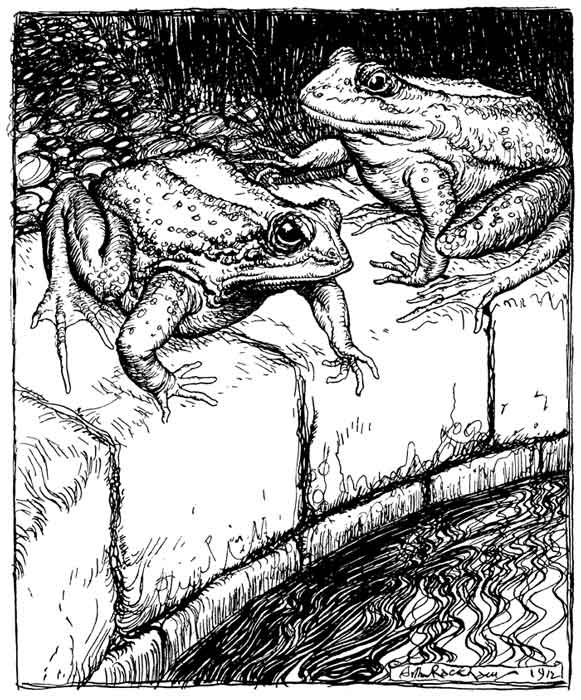
The Two Frogs
Two Frogs, no longer being able to remain in their fen, which had been dried up by the heat of the summer, agreed to go together and look for some water elsewhere. After having traveled far, they came to a well.
"Come," said the one to the other, "let us go down without seeking farther."
"You speak very much at your ease," said her companion, "but if the water should fail us here, how could we get out?"


The Monkey
"What a low and tiresome life is that which I lead in the forest with stupid animals, I who am the image of man!" exclaimed a Monkey, disgusted with living in the woods. "I must go and live in the cities with people who resemble me, and who are civilized." He thither went, but he repented soon: he was taken, chained, mocked, and insulted. 


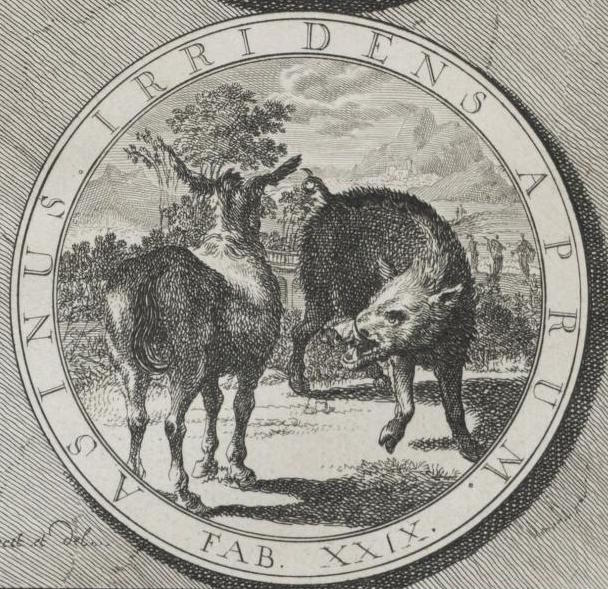
The Ass and the Wild Boar
An Ass had the impertinence to follow a Wild Boar and to bray at him in order to insult him. That courageous animal was at first irritated, but turning his head and seeing whence came the insult, he continued tranquilly on his way, not honoring the Ass with a single word.


The Eagle and his Eaglets
An Eagle rose with his Eaglets to the clouds. "How you stare at the sun!" said the little ones. "It does not dazzle you." 
"My sons," replied the king of the birds, "my father, my grandfather, great-grandfather, and my ancestors hvae looked at the sun in the same way; follow their example and mine, and the sun will never be able to make you close your eyes."


John Ogilby (1)

lJohn Ogilby's fables in verse is one of the major Aesopic projects of the 17th century. You can read more about Ogilby's life and career at Wikipedia. The first edition of Ogilby's fables featured engravings by Francis Cleyn; the later 1668 edition (which you can find online at the Internet Archive) features engravings by Wenceslaus Hollar, which you will see below.

Here are five of Ogilby's verse fables:


Of the Bear and the Bees

Bruine the Bear receiving a slight Wound
From a too waspish Bee,
Joyful to raise a War on any ground,
(It was their Wealth had done the injury)
Did now propound,
And to himself decree,
Ne'r to return, till he had overthrown
Twelve Waxen Cities of that Nation,
And seiz'd their Honey-Treasure as his own.

This being resolv'd, he to the Garden goes,
Where stood the stately Hives,
One, after one, the Barbarous overthrows,
And many Citizens of Life deprives:
A few survives,
Who in a Body close;
For your everted Towr's, your slaughter'd Race,
For your great Losses, and your high Disgrace,
Fix all your venom'd Weapons in his Face.
This said, the Trumpet sounds, the Vulgar rage,
And all at once in mighty War ingage.

Now Bruine's ugly Visage did not freeze,
Nor his foul hands want Groves;
The monstrous Bear you could not see for Bees,
No Bacon Gamon was so stuck with Cloves:
Who Honey loves
Not with Sharp Sawce agrees.
Ore-power'd by multitude, and almost slain,
He draws his shatter'd Forces off again;
Then said; I better had endur'd the pain
Of one sharp Sting, than thus to suffer all;
Making a Private Quarrel National.

MORAL.
Great Kings, that petty Princes did despise,
Have oft by War's Experience grown Wise:
Who whip'd the Sea, and threatned Floods to Chain,
Brought back for Millions but a slender Train.


Of the Hawk and the Cuckow

Unworthy Bird, base Cuckow, thou that art
Large as my self in every part,
Strength, length, and colour of thy Wing,
Mine much resembling;
Whose narrow Soul, whose no or little Heart,
Will to thy board
Afford
Nothing but Worms of Putrefaction bred;
Which of the Noblest Mortals are abhorr'd,
Since they must turn to such when they are dead;
Mount, gorge thy self with some delicious Bird;
Be wise,
Such Banquets leave for Daws, and silly Pies.
Thus the bold Hawk the Cuckow did advise.

Who not long after taken in the Field,
Having a harmless Pidgeon kill'd.
Was in a most unlucky hour
Hung from a lofty Tow'r;
To teach all those, who blood of Innocents spill'd.
The Cuckow saw,
by Law
The Murtheress suffer'd; when these Notes she sung;
Better with Worms to fill my hungry Maw,
Then betwixt Heaven and Earth by th' heels be Hung,
And a Cold Bird ly in my Stomach Raw.
Had I Thy Counsel took, and forrag'd through the Sky,
There had I hang'd with thee for Company.

MORAL.
Some without Conscience plunger, spoyl, and kill,
As if for Bloody Banquest were no Bill:
But Vengeance Spring-tides hath, as well as Neap,
When Malefactors short from Ladders leap.


Of the Rustick and Hercules

O Thou that didst so many Monsters kill,
And of twelve labours didst none ill,
Help, if it be thy will.
O thou that forc'd fire-spitting Cacus Den,
And got'st' thy Cattel then,
Though mine I ne'r could have agen.
Alcides, thou that art the strongest God,
Help with thy long Arms out, and Shoulders broad,
My Wheels, which stick up to the Nave in Mire:
Ah! 'tis a mighty Load,
Help, I desire,
Or here I will expire.
In a deep Tract his Cart being lodg'd thus prayd
A lazy Swan to Hercules for Aid.

When thus the Deity in a mighty Crack
Of Thunder to the Rustick spake,
Then lying on his back;
Fool, whip thy pamper'd Horses up the Hill,
Thy Shoulder lay to th' Wheel,
And there use all thy Strength and Skill:
Not only me whom now thou dost Invoke,
But then expect a God at every Spoke
To thy assistance, who offended be,
When they implor'd shall look
From Heaven, and see
 A heavy Clown like thee.

MORAL.
Under the Tropicks more refined Souls
Cherish old Piety: but neer the Poles
Men follow War, Sail, Bargain, Sow, and Reap,
And no Religion love, but what is Cheap.


Of the Fox and Ape

The French Ape gives the Fox of Spain Bon jour
Three Congees, and Tres humble Serviture:
Then thus begins; In France we not indure
To see long Cloaks, all there
Go in the shortest Wear,
But your large Fashion is the Statelier sure.
Pardonne moy, as we are all too short,
In Curtail'd Garments, A la modes o' th' Court,
So with th' other Extreme, yours sir, doth sort.
Be pleas'd to wear your Fur
A little shorter, Sir;
'T will be as grave, and suit well with your Port.
Seignour, I know your Taylor is not here,
My Apeship's Workman, quickly with his Share
Shall cut you shorter, and my Self will wear
The remnant of your Train,
Comfortable to Spain:
And then Don Diegoes both we shall appear.

Si Sennor, said the Fox, we Dons of Spain
Are constant to our Fashion, such a Train
My Father's Father wore; and to be plain,
This Long Wear I will keep,
Though it the Kennel sweep:
Rather than Give an Inch to Monsieur Vain.

MORAL.
Heaven to each nation several Genius gave;
The French too Airy, Spaniards seem too Grave:
City, the Country; Courtiers both despise;
Civil, and Rude, most their own Manners prise.


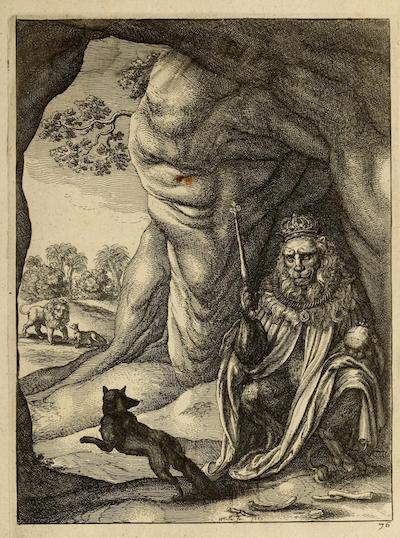
Of the Fox and the Lion

Oh! all you Gods and Goddesses that dwell
In Heaven and Earth, in Heaven, Earth, Sea, and Hell.
If all your Power Conjoyn'd can one Protect,
Save the poor Fox,
Nor Prayer reject.
What is it I behold?
His shaggy Locks,
Are prest with shining Gold.
It is the Lion; See! his spreading Robe
Covers at least half the Terrestrial Globe:
Terror of Beasts and Man,
Whose hard Teeth can
Crack Brazen bones of the Leviathan.
Help, help, if me he not in pieces tears,
I shall in sunder Shake with my own Fears.

At first the Fox thus Trembled to behold
the Scepter'd Lion, Arm'd and Crown'd with Gold.
But when the King the second time he saw
Hunting in green,
Not so much Awe
Did in his Looks appear,
Less Majesty in's Mein,
Then Reynard drew more neer;
But the third day the bold Beast had the Face
To come up close, and cry'd, Jove save your Grace.
At last so need did stand,
He kist his Hand,
Soon after did the Royal Ear Command,
In which he said; Custome makes Mortals Bold,
To Play with that they durst not once behold.

MORAL.
Who Hate to Draw a Sword, and Guns abhor,
Custome hath made most Valiant Men of War.
Love's Novice so, trembling, fresh Beauty storms,
Which soon lies ruffled in his Conquering Arms.


Joseph Jacobs (1)

In addition to his masterful edition of Caxton's Aesop (volume 1 - volume 2), Joseph Jacobs also wrote a book of Aesop's fables for a general audience: The Fables of Aesop, with illustrations by Richard Heighway. That book contains an introduction which is an abbreviated version of his lengthy introduction in the Caxton edition: A Short History of the Aesopic Fable, and you will also find this wonderful chart in the back of that book which sketches out the wider Aesop (click the image for a larger view):


Here are five of the fables in Jacobs' book; click here for more from Jacobs:

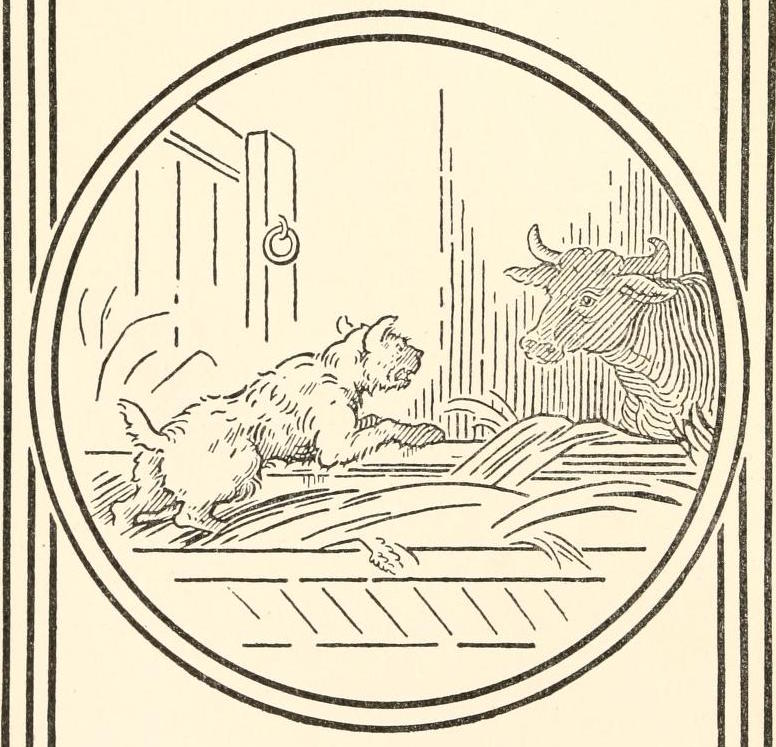
The Dog in the Manger 
A Dog looking out for its afternoon nap jumped into the Manger of an Ox and lay there cosily upon the straw. But soon the Ox, returning from its afternoon work, came up to the Manger and wanted to eat some of the straw. The Dog in a rage, being awakened from its slumber, stood up and barked at the Ox, and whenever it came near attempted to bite it. At last the Ox had to give up the hope of getting at the straw, and went away muttering:
"Ah, people often grudge others what they cannot enjoy themselves."


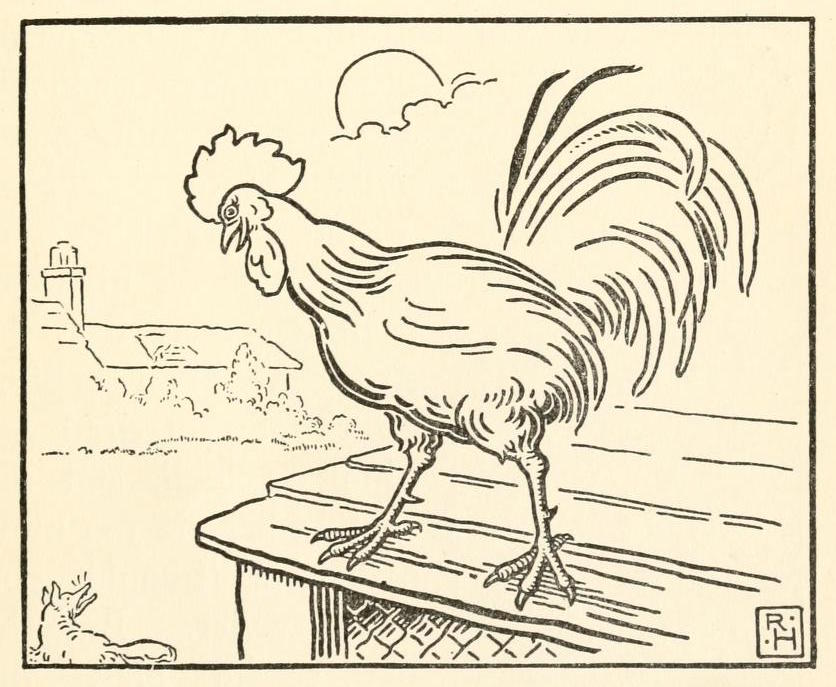
The Fox, the Cock, and the Dog 
One moonlight night a Fox was prowling about a farmer's hen-coop, and saw a Cock roosting high up beyond his reach. "Good news, good news!" he cried.
"Why, what is that?" said the Cock.
"King Lion has declared a universal truce. No beast may hurt a bird henceforth, but all shall dwell together in brotherly friendship."
"Why, that is good news," said the Cock; "and there I see some one coming, with whom we can share the good tidings." And so saying he craned his neck forward and looked afar off.
"What is it you see?" said the Fox.
"It is only my master's Dog that is coming towards us. What, going so soon?" he continued, as the Fox began to turn away as soon as he had heard the news. "Will you not stop and congratulate the Dog on the reign of universal peace?"
"I would gladly do so," said the Fox, "but I fear he may not have heard of King Lion's decree."
Cunning often outwits itself.


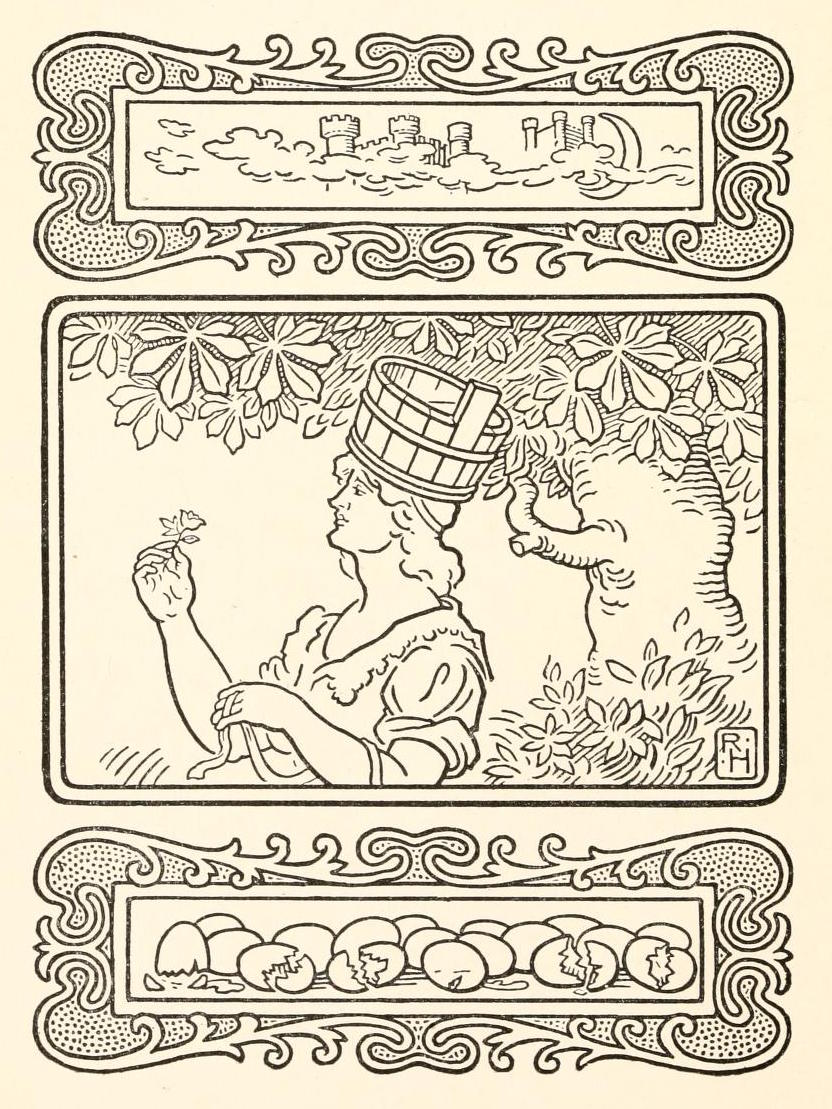
The Milkmaid and Her Pail 
Patty the Milkmaid was going to market carrying her milk in a Pail on her head. As she went along she began calculating what she would do with the money she would get for the milk. "I'll buy some fowls from Farmer Brown," said she, "and they will lay eggs each morning, which I will sell to the parson's wife. With the money that I get from the sale of these eggs I'll buy myself a new dimity frock and a chip hat; and when I go to market, won't all the young men come up and speak to me! Polly Shaw will be that jealous; but I don't care. I shall just look at her and toss my head like this. As she spoke she tossed her head back, the Pail fell off it, and all the milk was spilt. So she had to go home and tell her mother what had occurred.
"Ah, my child," said the mother,
"Do not count your chickens before they are hatched."


The Hare With Many Friends
A Hare was very popular with the other beasts who all claimed to be her friends. But one day she heard the hounds approaching and hoped to escape them by the aid of her many Friends. So, she went to the horse, and asked him to carry her away from the hounds on his back. But he declined, stating that he had important work to do for his master. "He felt sure," he said, "that all her other friends would come to her assistance." She then applied to the bull, and hoped that he would repel the hounds with his horns. The bull replied: "I am very sorry, but I have an appointment with a lady; but I feel sure that our friend the goat will do what you want." The goat, however, feared that his back might do her some harm if he took her upon it. The ram, he felt sure, was the proper friend to apply to. So she went to the ram and told him the case. The ram replied: "Another time, my dear friend. I do not like to interfere on the present occasion, as hounds have been known to eat sheep as well as hares." The Hare then applied, as a last hope, to the calf, who regretted that he was unable to help her, as he did not like to take the responsibility upon himself, as so many older persons than himself had declined the task. By this time the hounds were quite near, and the Hare took to her heels and luckily escaped.
He that has many friends, has no friends.


The Man, the Boy, and the Donkey
A Man and his son were once going with their Donkey to market. As they were walking along by its side a countryman passed them and said: "You fools, what is a Donkey for but to ride upon?"
So the Man put the Boy on the Donkey and they went on their way. But soon they passed a group of men, one of whom said: "See that lazy youngster, he lets his father walk while he rides."
So the Man ordered his Boy to get off, and got on himself. But they hadn't gone far when they passed two women, one of whom said to the other: "Shame on that lazy lout to let his poor little son trudge along."
Well, the Man didn't know what to do, but at last he took his Boy up before him on the Donkey. By this time they had come to the town, and the passers-by began to jeer and point at them. The Man stopped and asked what they were scoffing at. The men said: "Aren't you ashamed of yourself for overloading that poor donkey of yours and your hulking son?"
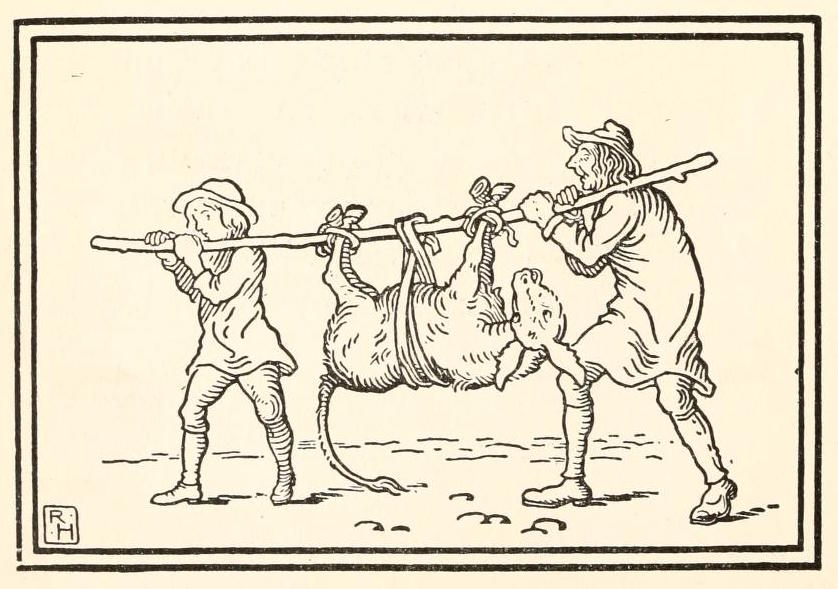
The Man and Boy got off and tried to think what to do. They thought and they thought, till at last they cut down a pole, tied the donkey's feet to it, and raised the pole and the donkey to their shoulders. They went along amid the laughter of all who met them till they came to Market Bridge, when the Donkey, getting one of his feet loose, kicked out and caused the Boy to drop his end of the pole. In the struggle the Donkey fell over the bridge, and his fore-feet being tied together he was drowned.
"That will teach you," said an old man who had followed them:
"Please all, and you will please none."


William Caxton (1)

Here are some more fables from the The Fables of Aesop as printed by William Caxton in 1484, with woodcuts adapted from Steinhowel's Aesop:

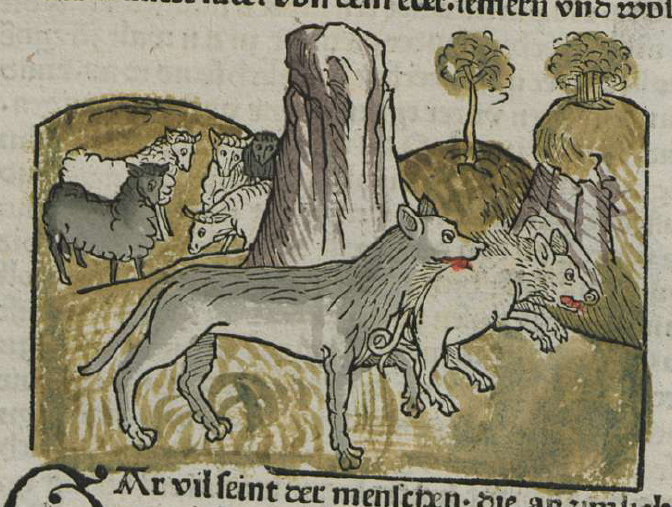
Of the bore and of the wulf
Svche desyren to be grete lordes / and dyspreysen his parents / that at the last becomen poure and fallen in to grete dishonour / As thow mayst see by this present fable / 
Of a bore / whiche was amonge a grete herd of other swynes / 
And for to haue lordship and domynacion ouer alle them / he beganne to make grete rumour / and shewed his grete teethe for to make the other swynes aferd / but by cause they knewe hym / they sette nought by hym / wherof he displeased moche / and wold goo in to a herd of sheep / and emonge lambes / And whanne he was amonge the lambes / he began to make grete rumour / and shewed his sharp and long teeth / And whanne the lambes herd hym / they were sore aferd / and byganne to shake for fere / 
And thenne sayd the bore within hym self / here is the place wherin I must abyde & duelle For here I shalle be gretely worshipped / For euerychone quaken for fere of me / 
Thenne came the wulf there for to haue and rauysshe somme proye / And the lambes beganne alle to flee / but the bore as prowd wold not stere hym / ne go fro the place / by cause he supposed to be lord / but the wulf toke hym / and bare hym in to the wode for to ete hym / 
And as the wulf bare hym / it happed that he passid before the herd of swynes / whiche the bore had lefte / 
And thenne whanne the bore perceyued and knewe them / he prayd and cryed to them / that for the loue of god they wold help hym / And that withoute her help / he was deed / 
And thenne the swynes alle of one assent and owne wylle wente and recouered theyr felawe / and after slewe the wulf / 
And as the bore was delyuerd / and sawe hym amonge the swynes / and that alle his doubte and fere was gone / he beganne to haue vergoyne and shame / by cause that he was thus departed / and gone fro theyr felauship and sayd to them / My bretheren and my frends / I am well worthy to haue had this payne / by cause / I was gone & departed from yow /
And therfore he that is wel / lete hym beware / that he moue not hym self / For suche by his pryde desyreth to be a grete lord / whiche ofte falleth in grete pouerte /


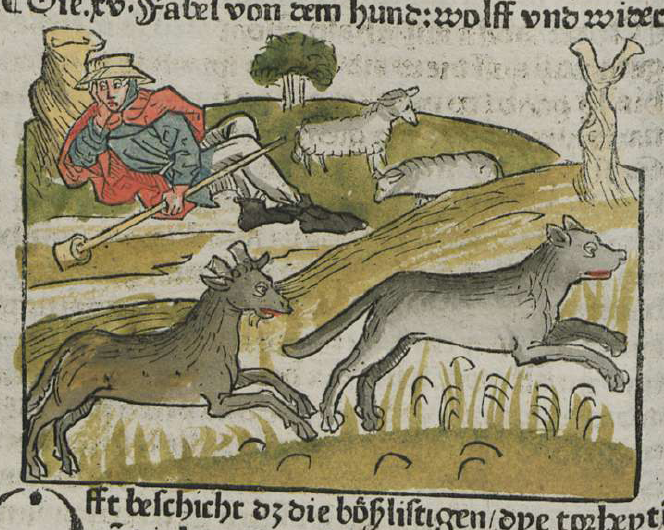
Of the dogge / of the wulf and of the whether
Grete folye is to a fool that hat no myght / that wylle begyle another stronger than hym self / as reherceth this fable 
Of a fader of famylle whiche had a grete herd or flock of sheep / and had a grete dogge for to kepe them which was wel stronge /
And of his voys all the wolues were aferd wherfore the sheepherd slepte more surely / but it happed / that this dogge for his grete age deyde / wherfore the sheepherdes were sore troubled and wrothe / and sayd one to other / we shall nomore slepe at oure ease by cause that our dogge is dede / for the wulues shall now come and ete our sheep / and thenne a grete wether fyers and prowd / whiche herd alle these wordes came to them and sayd / I shalle gyue yow good counceylle / Shaue me / and put on me the skynne of the dogge
And whanne the wulues shalle see me / they shalle haue grete fere of me /
And whanne the wulues came and sawe the wether clothed with the skynne of the dogge / they beganne all to flee / and ranne awey / t happed on a day that a wulf whiche was sore hongry / came and toke a lambe / and after ran awaye therwith / And thenne the sayd wether ranne after hym / 
And the wulf whiche supposed that it had ben the dogge shote thryes by the waye for the grete fere that he had / 
And ranne euer as fast as he coude / and the wether also ranne after hym withoute cesse / tyl that he ranne thurgh a busshe full of sharp thornes / the whiche thornes rente and brake alle the dogges skynne / which was on hym /
And as the wulf loked and sawe behynde hym / beynge moche doubtuous of his dethe / sawe and perceyued alle the decepcion and falshede of the wether / 
And forthwith retorned ageynste hym / and demaunded of hym / what beest arte thow / 
And the wether ansuerd to hym in this maner / My lord I am a wether whiche playeth with the / 
And the wulf sayd / Ha mayster ought ye to playe with your mayster and with your lord / thow hast made me so sore aferd / that by the weye as I ranne before the / I dyde shyte thre grete toordes / 
And thenne the wulf ledde hym vnto the place where as he had shyte / sayenge thus to hym / Loke hyther / callest thow this a playe / I take hit not for playe / For now I shalle shewe to the / how thou oughtest not to playe so with thy lord / 
And thenne the wulf took and kylled hym / and deuoured and ete hym /
And therfore he that is wyse muste take good hede / how he playeth with hym whiche is wyser / more sage / and more stronge / than hym self is /


Of the dragon and of the kerle
Men ought not to rendre euylle for good / And them that helpen ought not to be letted / As reherceth thys fable 
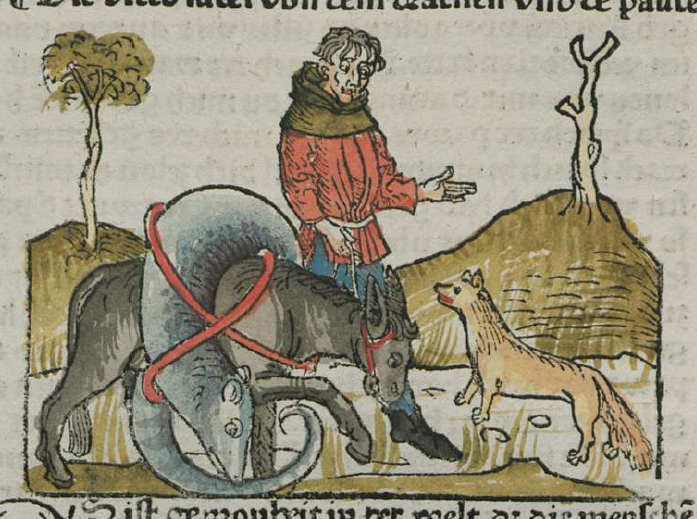
Of a dragon whiche was within a Ryuer / and as this Ryuer was dymynuysshed of water / the dragon abode at the Ryuage / whiche was al drye / And thus for lack of watre he coude not stere hym / 
A labourer or vylane came thenne that waye / and demaunded of the dragon / what dost thow there / 
And the dragon ansuerd to hym / I am here lefte withoute water / withoute whiche I can not meue / but yf thow wilt bynd me / and sette me vpon thyn asse / and lede me in to my Ryuer / I shal gyue to the habondaunce of gold and syluer / 
And the vylane or chorle for couetyse bound and ledde hym in to his repayre /
And whanne he had vnbounden hym / he demaunded his sallary / and payment / 
And the dragon sayd to hym / By cause that thow hast bounden me / thow wylt be payd And by cause that I am now hongry / I shalle ete the / 
And the vylayne ansuerd and sayd / For to haue done wel / thow wylt ete and deuoure me / 
And as they stryued to gyder / the foxe whiche was within the forest herd wel theyr question and different came to them / and sayd in this manere / Stryue ye no more to gyder / For I wyll acord / and make pees bytwixt you Late eche of yow telle to me his reason for to wete / whiche of yow hath ryght / 
And whanne eche of them had told his caas the foxe sayd to the vylayne / Shewe thow to me / how thow boundest the dragon / to thende / that I may gyue therof a trewe and lawfull sentence / 
And the vylayne put the dragon vpon his asse / and bound hym as he had done before / 
And the fox demaunded of the dragon / helde he thenne the so fast bounden / as he dothe now / 
And the dragon ansuerd / ye my lord / and yet more hard / 
And the foxe sayd to the vylayn / Bynde hym yet more harder / For who that was wel byndeth / wel can he vnbynd 
And whanne the dragon was fast and wel bounden / the fox sayd to the vylayne / bere hym ageyn there as thow fyrst tokest hym / And there thow shalt leue hym bounden as he is now / And thus shalle not ete ne deuoure the /
For he that dothe euylle / euylle he must haue / For Iustly he shall ben punysshed of god / they that done harme and dommage to the poure folke For who so euer rendreth euylle for good / he shalle therof iustly be rewarded


Of the enuyous dogge
None ought not to haue enuye of the good of other / As it appiereth by this fable / 
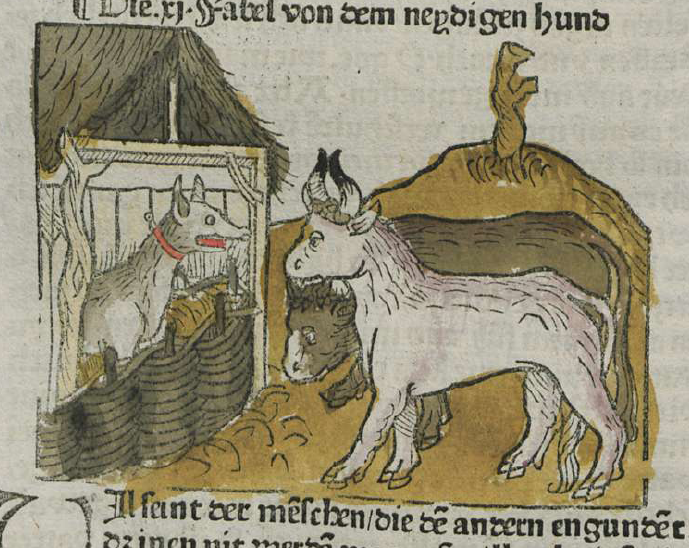
Of a dogge whiche was enuyous / and that somtyme was within a stable of oxen / the whiche was ful of heye / 
This dogge kept the oxen that they shold not entre in to theyr stable / and that they shold not ete of the sayd hey / 
And thenne the oxen sayd to hym / Thow arte wel peruers and euylle to haue enuye of the good / the whiche is to vs nedefull and prouffitable / And thow hast of hit nought to doo / for thy kynde is not to ete no hey / 
And thus he dyd of a grete bone / the whiche he held at his mouthe / and wold not leue hit by cause and for enuye of another dogge / whiche was therby /
And therfore kepe the wel fro the company or felauship of an enuyous body / For to haue to doo with hym hit is moche peryllous and dyffycyle / As to vs is wel shewen by Lucyfer


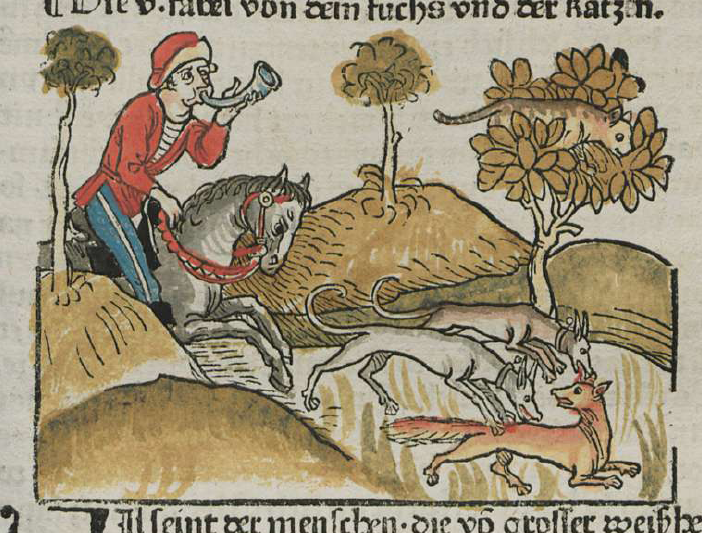
Of the foxe and of the catte
There is many folke / whiche auauncen them and saye that they ben wyse and subtyle / whiche ben grete fooles and knowynge no thynge / As this fable reherceth / 
Of a foxe whiche somtyme mette with a Catte / to whome he sayd / My godsep / god yeue yow good daye / 
And the catte ansuerd / My lord god gyue yow good lyf / 
And thenne the foxe demaunded of hym / My godsep what canst thow doo /
And the catte sayd to hym / I can lepe a lytyl / 
And the fox sayd to hym / Certaynly thow arte not worthy to lyue / by cause that thow canst nought doo / 
And by cause that the cat was angry of the foxes wordes / he asked and demaunded of the foxe / And thow godsep what canst tow doo / 
A thousand wyles haue I sayd the foxe / For I haue a sak ful of scyences and wyles / And I am so grete a clerke / that none may begyle ne deceyue me /
And as they were thus spekyng to gyder the cat perceyued a knyght comynge toward them / whiche had many dogges with hym / and sayd to the foxe / My godsep / certaynly I see a knyght / comynge hytherward / whiche ledeth with hym many dogges / the whiche as ye wel knowe ben our enemyes / 
The foxe thenne ansuerd to the cat / My godsep / thou spekest lyke a coward / and as he that is aferd / lete them come and care not thow / 
And Incontynently as the dogges perceyued and sawe the foxe and the catte / they beganne to renne vpon them / 
And whanne the foxe sawe them come / he sayd to the kat / Flee we my broder / flee we / 
To whome the kat ansuerd / Certaynly godsep / therof is none nede /
Neuertheles the foxe byleued not the cat / but fledde / and ranne as fast as he myght for to saue hym / 
And the catte lepte vpon a tree and saued hym self / sayenge / Now shalle we see / who shalle playe best for to preserue and saue hym self / 
And whanne the catte was vpon a tree / he loked aboute hym / and sawe how the dogges held the foxe with theyr teethe / to whome he cryed and seyd / O godsep and subtyle foxe / of thy thowsand wyles that syth late thow coudest doo / lete me now see / and shewe to me one of them / 
The foxe ansuerd not / but was killed of the dogges and the catte was saued /
And therfore the wyse ought not to disprayse the symple / For suche supposeth to be moche wyse / whiche is a kynd and a very foole /