Monday, October 9, 2023

Clarke: English (28)

Here are some more fables from H. Clarke's Latin textbook Fabulae Aesopi selectae, or, Select fables of Aesop, and you can click here for all the fables reposted from this book at the blog.


136. Of an Ass Being Sick, and Wolves Visiting Him
An ass was sick, and report had gone out that he would die quickly; therefore, when the wolves had come to see him and asked of the son how his father did, he answered through the chink of the door, "Better than ye would have him."
Moral. This fable shows that many feign to bear the death of others with trouble, whom yet they desire to perish quickly.


Lupi et Asinus Aegrotus


137. Of a Nut-Tree, an Ass, and a Woman
A certain woman asked a nut-tree growing by the wayside, which was beaten with stones by the people passing by, why it was so mad that by how much it was beaten with more and greater stripes, by so much it yielded more and better fruits? To whom it said, "Art thou unmindful of the proverb saying thus: a nut-tree, an ass, and a woman are bound by a like law. These three do nothing rightly if blows cease."
Moral. This fable shows taht men often are wont to wound themselves with their own darts.


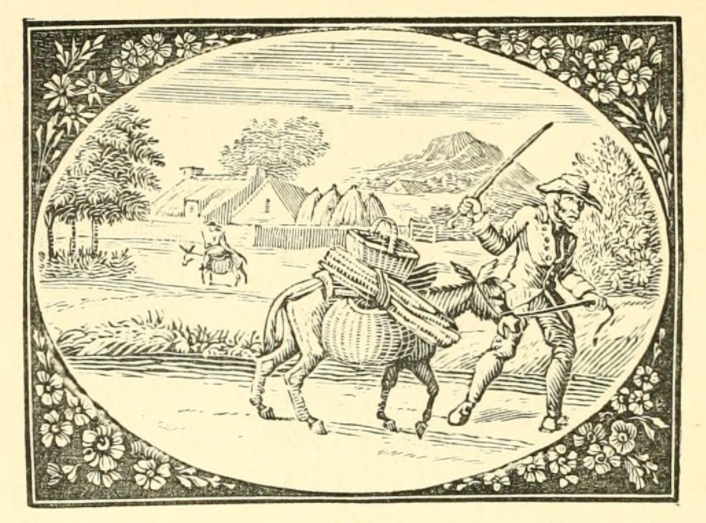
138. Of an Ass, Not Finding an End of His Labors
An ass was grieved very much in winter time that he was affected with too much cold and had hard meat of chaff, wherefore he desired the spring season and the tender grass. But when spring came and he was compelled by the master, who was a a potter, to carry clay into the yard and wood to the furnace, and thence bricks and tiles to diverse places. Tired of the spring, in which he bore so many labors, he hoped for summer, that the master, being hindered by the harvest, would suffer him to rest, but then also, when he was compelled to bear the corn into the barn, and thence the wheat home, nor was there space for rest for him. At least he hoped tha tautumn would be the end of his labors, but, when not then also he perceived an end of evils, seeing that daily wine, apples, and wood were to be carried, again he desired the snow and ice of winter, that then at least some rest might be granted to him from such great labors.
Moral. This fable shows that there are no times of the present life which are not subject to perpetual labors.


139. Of a Mouse Who Was Willing to Contract Friendship with a Cat
Many mice dwelling in the hollow of a wall, espied a cat, who lay on the boarded floor, with her head hung down, and a sad countenance. Then one of them said, this animal seems very kind and milkd; for she shows a certain sanctity in her very countenance; I am willing to speak to her and to knit an indissoluble friendship with her; which things when he had said, and had approached nearer, he was taken and torn to pieces by the cat. Then the rest, seeing this, said wish themselves, truly we must not trust rashly to the countenance.
Moral. This fable hints that men are not to be judged by the countenance, but by actions: seeing that fierce wolves often lie hid under a sheep's skin.

Feles Senex et Mus


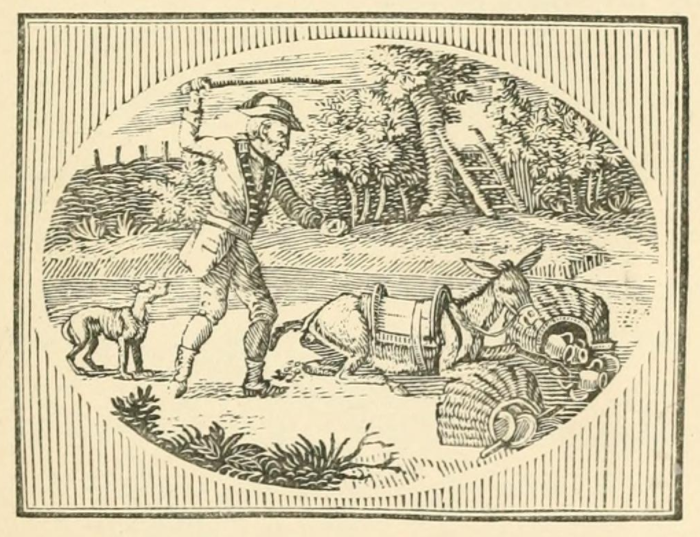
140. Of an Ass, Who Served an Ungrateful Master
An ass, who had served an ungrateful master many years with an inoffensive foot, once, as it happens while he was pressed with a heavy load, and went in an uneven way, fell under the burden. Then the implacable master compelled him to rise with many blows, calling him an idle and dull animal. But the miserable ass said with himself, among these stripes, unhappy I, who have got so ungrateful a master! For although I have served him a long time without offence, yet he does not weigh this one fault with my so many former benefits.
Moral. This fable was feigned against those who unmindful of benefits conferred on them prosecute even the least offence of their benefactor with cruel punishment.



Roger L'Estrange (28)

Here are some more fables from Roger L'Estrange's Fables of Aesop and Other Eminent Mythologists, and you can click here for all the L'Estrange fables at this blog.


A Snake to Jupiter
A Snake that found himself persecuted by Men, appeal'd to Jupiter for Relief; who told him that it was his own Fault; for (says he) if you had but bit the first Man that affronted ye; the second would have taken warning by't.
The putting up of one Affront draws on another.


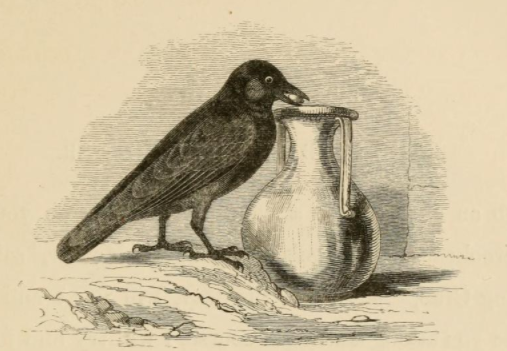
A Crow and a Pitcher
A Crow that was extream thirsty, found a Pitcher with a little Water in't, but it lay so low he could not come at it. He try'd first to break the Pot and then to over-turn it, but it was both too strong, and too heavy for him. He bethought himself however of a Device at last that did his Bus'ness; which was, by dropping a great many little Pebbles into the Water, and raising it that way, till he had it within Reach.
There is a Natural Logick in Animals over and above the Instinct of their Kinds.


A Wench parting with her Sweetheart
A Common Wench was wringing her Hands, and crying herself to Death almost; and what was the Business forsooth, but she had newly parted with her Sweet-Heart. Away, ye Fool you (says one of her Neighbours) to torment yourself out of your Life for such a Fellow as this! Nay, says the Lass, I am not so much troubled at parting with the Man; but he has carry'd away his Coat too; and truly, when he had given me all he had in the World beside, methinks I have e'en might had that too as well as all the rest.
Here's a Mercenary Prostitute drawn to the very quick, that lays her Profit more to Heart than her Love.


The Washing of a Blackmore
A Man gave Money for a Black, upon an Opinion that his Swarthy Colour was rather Sluttery than Nature; and the Fault of his last Master, in a great Measure, that he kept him no Cleaner: He took him Home with him, and try’d all manner of Washes to bring him to a Better Complexion; but there was no Good to be done upon him; besides, that the very Tampering cast him into a Disease.
Natural Inclinations may be Moulded and Wrought upon by Good Councel and Discipline; but there are certain Specifick Properties and Impressions, that are never to be Alter’d or Defac’d.


A Generous Lion
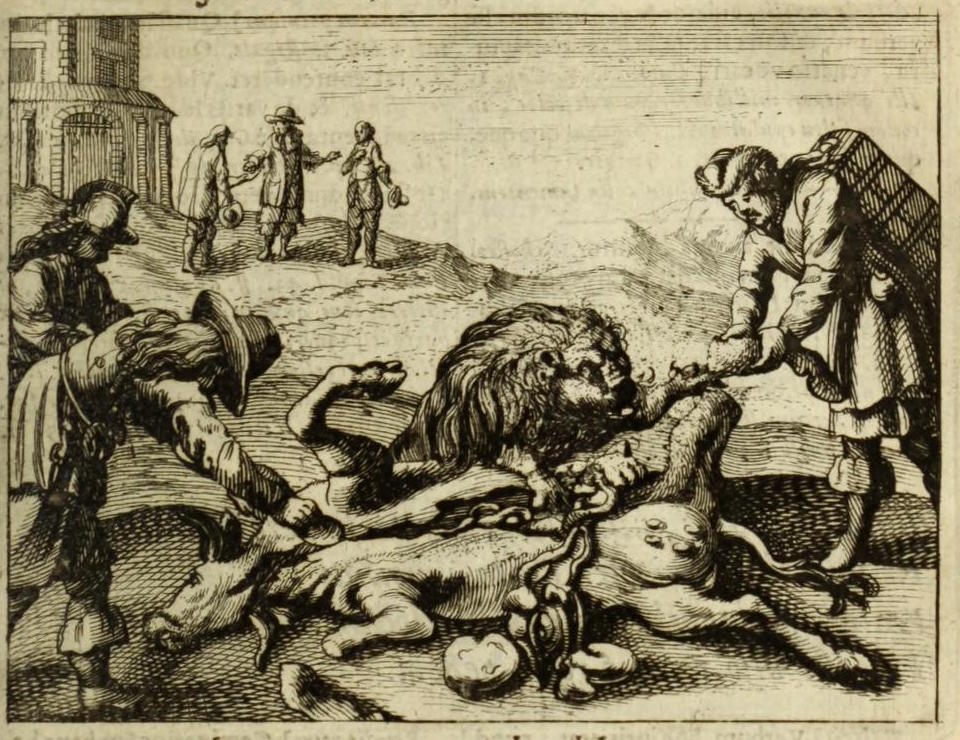
As a Lion was Bestriding an Ox that he had newly Pluck'd down, a Robber passing by, Cry'd out to him, Half-Shares. You should go your Snip says the Lion, if you were not so forward to be your own Carver. The Thief had but just turn'd his Back, when up comes an Innocent Traveller, that so soon as ever he saw the Lion, was going off again. The Lion bad him Fear Nothing, but take part of the Prey with him in Reward of his Modesty; Whereupon the Lion went immediately into the Woods to make Way for the Traveller.
If Great Men in the World would but follow the Example of the Lion in this Fable, Sharpers should not Ride in Triumph any longer, while Honest Men go out at the Elbows.


Thursday, October 5, 2023

Clarke: English (27)

Here are some more fables from H. Clarke's Latin textbook Fabulae Aesopi selectae, or, Select fables of Aesop, and you can click here for all the fables reposted from this book at the blog.


131. Of the Birds Being Willing to Choose More Kings
The birds consulted about choosing more kings, seeing that the eagle alone was not able to rule so great flocks of birds, and they would have done enough to their wish unless they had desisted from the counsel by the advice of the crow who, when the cause was asked why she did not think more kings were to be chosen, said, "Because many bags are filled more difficultly than one."
Moral. This fable teaches it to be by far better to be governed by one than by many princes.


132. Of a Woman Who Said that She Was Willing to Die for Her Husband
A certain matron, very chaste and most loving of her husband, bore it ill that her husband was kept down by bad health. She lamented, she grieved and, that she might testify her love to her husband, she asked Death that, if he was about to snatch her husband from her, he rather would kill her than him. Amidst these words, she beholds Death coming with horrible aspect, with the fear of whom being affrighted, and now repenting of her vow, she said, "I am not he whom thou seekest; he lies in the bed whom thou comest about to kill."
Moral. This fable shows that no one is so loving of a friend, who had not rather it was well to himself than another.

Femina, Maritus et Mors


133. Of a Young Man Singing at the Funeral of His Mother
A certain man followed his dead wife who was borne to the grave with tears and weepings, but his son sung, who, when he was blamed by the father as mad who could sing at the burial of a mother when he ought to be sad and to weep together with him, said, "My father, if you have hired priests that they might sing, why are you angry with me singing gratis?" To whom the father said, "Thy office and that of the priests is not the same."
Moral. This fable shows that all things are not decent for all men.


134. Of a Jealous Man Who Had Given His Wife to Be Guarded
A jealous man had given his wife, whom he had found to live but little chastely, to a certain friend, to whom he could trust very much, to be guarded, having promised much money if he would observe her so diligently that by no method she might violate the conjugal tie. But he, when he had experienced this charge too difficult some days and had found his wit to be overcome by the cunning of the woman, going to the husband, said that he was unwilling to bear this so hard a task any longer, seeing that not Argus indeed, who was all eyed, could be able to keep an unchaste woman. He added, moreover, if it was necessary that he had rather carry down a sack full of fleas into a meadow daily for a whole year and, the sack being loosed, to feed them among the grass and in the evening to bring them back all home than to keep an unchaste woman one day.
Moral. This fable shows that no guards are so diligent who can be able to guard unchaste women.


135. Of a Man Refusing Clysters
A certain man, a German by nation, very rich, was very sick, to cure whom many physicians came (for the flies fly in heaps to the honey) one of whom said, among other things, that there was need of clysters if he was willing to grow well, which when the man heard, unused to a medicine of this kind, moved with anger, he commands the physicians to be cast out of the house, saying that they were mad who, when the head grieved, were willing to cure the breech.
Moral. This fable shows that all things, although healthful, seem both rough and hurtful to the unaccustomed and inexperienced.