Tuesday, November 14, 2023

Clarke: English (38)

Here are some more fables from H. Clarke's Latin textbook Fabulae Aesopi selectae, or, Select fables of Aesop, and you can click here for all the fables reposted from this book at the blog.


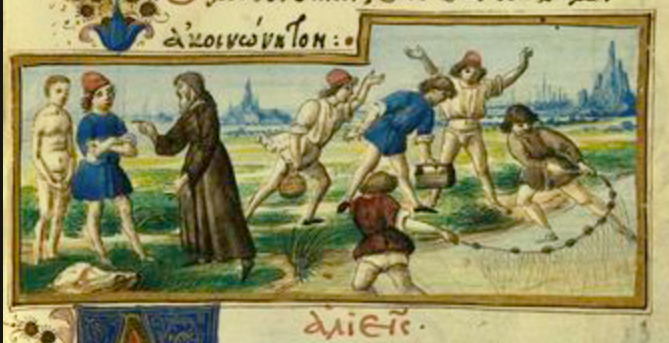
186. Of the Fishermen
Certain fishermen drew their net out of the sea, which when they perceived to be heavy, they rejoiced greatly, thinking that there were many fishes, but as soon as they had dragged the net on the land, when they perceive few fishes indeed, but a vast stone to be in the net, they become sad. A certain one of them, now advanced in age, says prudently to his companions, "Be ye of quiet minds, for sorrow is the sister of gladness, for it behooveth us to foresee future mischances, and that any man may bear them more lightly to persuade himself that they will come to pass."
Moral. This fable signifies that he who remembereth human lot, is affected the least in adverse affairs.


187. Of a She-Cat Changed into a Woman
A certain cat, taken with the love of a certain beautiful young man, besought Venus, that she would change her into a woman. Venus, having pitied her, changed her into the shape of a woman, whom, when she was very beautiful, the lover led home. But when they sat together in the chamber, Venus, willing to try  if, the face being changed, she had changed also her morals, placed a mouse in the middle; which, when she saw, having forgot her shape and love, she pursued the mouse that she might take her; upon which thing Venus, being angry, again changed her into the former shape of a cat.
Moral. The fable signifies that a man, although he may change his character, yet retains the same manners.
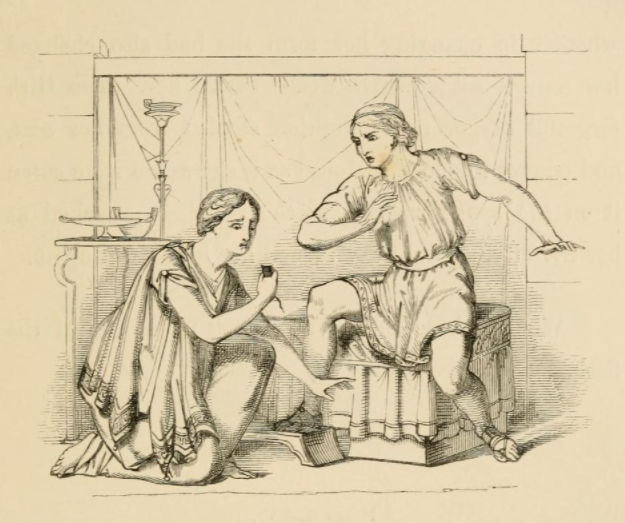


188. Of Two Enemies
Tow certain men having enmities between themselves sailed together in a ship. And when the one would not suffer the other to stand in the same place, one sat at the head, the other at the stern. But a tempest having arose, when the ship was in danger, he that sat at the prose asks the governor of the ship, what part of the ship would be sunk first, and when the pilot had said the stern, he said, "Death now is not so troublesome to me if I perceive my enemy to die first."
Moral. This fable reproves the enmities of men; when an enemy very often chooses to destroy himself that he may destroy his enemy.


189. Of a Dog and a Smith
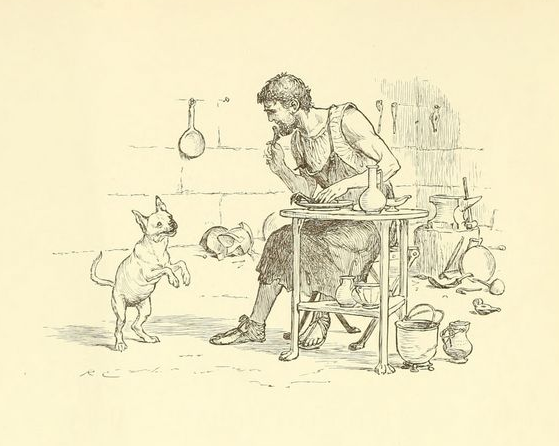
A certain smith had a dog which, whilst he struck the iron, slept continually, but when he was eating, the dog immediately rose up and, without delay, gnawed those things which were thrown down under the table, as bones and other things of this kind, which thing the smith perceiving, he says to the dog, "So ho, wretch, I know not what I shall do to thee; who, whilst I strike the iron, sleepest continually and art possessed with sloth; again when I move my teeth, presently thou risest, and flatterest me with thy tail."
Moral. The fable signifies that the slothful and drowsy, who live out of the labours of others, are to be restrained with a heavy censure.


190. Of a Certain Mule
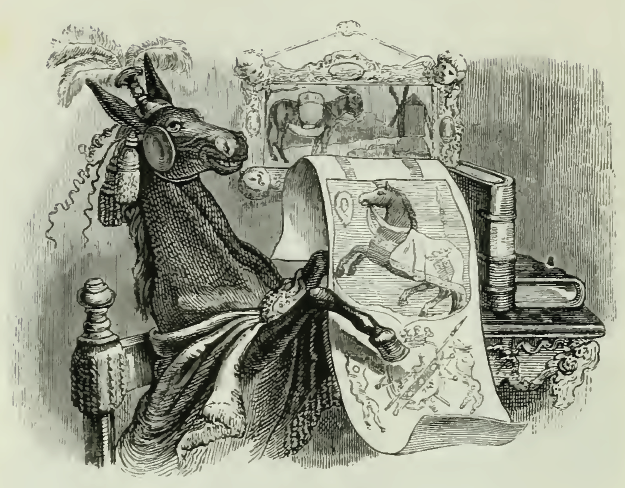
A certain mule, being made fat with too much barley, wantoned with too much fatness, saying with herself, "A horse was my father who was swiftest in the race, and I am like him in all things." A little after, it happened that it behooved the mule to run as much as she could, but when she ceased from running, she said, "Alas! Wretched me, who thought myself to be the offspring of a horse! But now I remember that my father was an ass."
Moral. The fable signifies that fools do not know themselves in prosperous things, but in adverse things very often they again know their errors.

Clarke: English (37)

Here are some more fables from H. Clarke's Latin textbook Fabulae Aesopi selectae, or, Select fables of Aesop, and you can click here for all the fables reposted from this book at the blog.


181. Of an Eagle and a Man
When a certain man had taken an eagle, the feathers of the wings being plucked from her, he dismissed her to dwell amon ght ehens. Afterwards a certain man, having purchased her, fortifies her wings with feathers; then the eagle, flying, takes a hare and bears him to her benefactor. Which thing a fox perceiving, he says to the man, be unwilling to have this eagle in your house, lest she hunt thee as well as the hare. Then the man also plucked off the feathers from the eagle.
Moral. This fable signifies that benefactors indeed are to be required, but the wicked altogether to be avoided.


182. Of an Husbandman
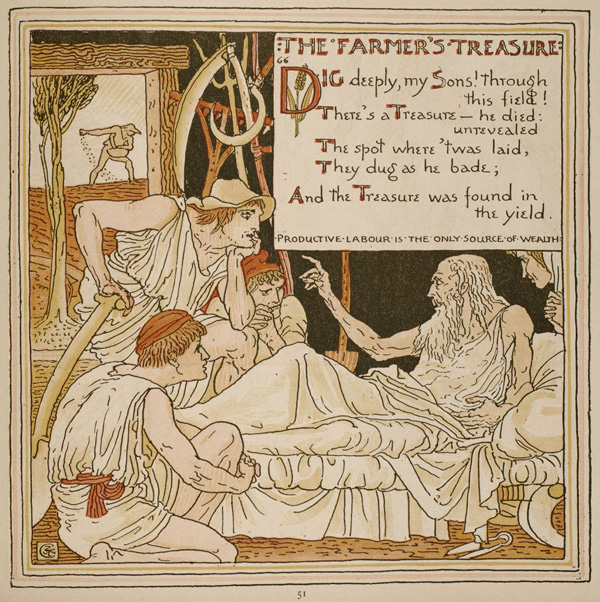
A certain man, being a husbandman, when he knew that there was an end of life to him and desired his son to become skillful in the tillage of lands, called them, and said, "O sons, I depart out of life; all my goods are placed in the vineyard." They, after the death of the father, thinking to find this treasure in the vineyard, spades, mattocks, and prongs being taken, entirely dig up the vineyard and do not find the treasure, but, when the vine was well dug up, it produced by far more fruits than usual and made them rich.
Moral. This fable signifies that daily labour bringeth forth treasure.


183. Of a Certain Fisherman
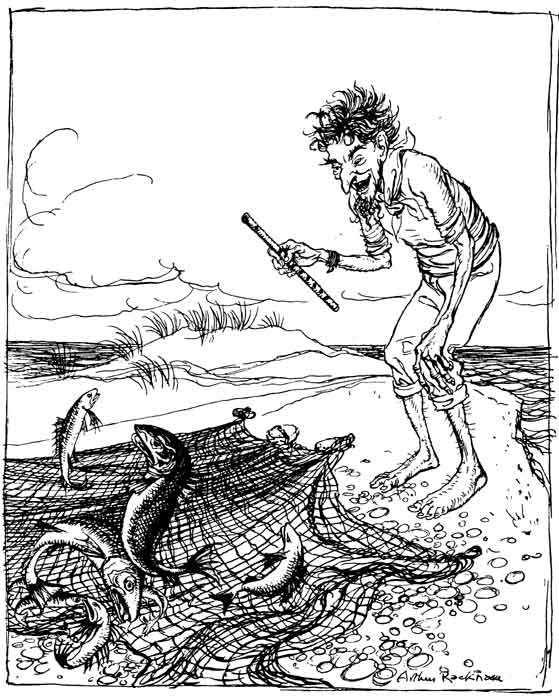
A certain fisherman unskillful in fishing, his net and pipes being taken, goes near the shore of the sea and, standing up on a certain rock, he began at first to pipe, thinking that he should take fishes easily with a tune, but when he obtained no effect with a tune, the pipes being laid down, he let down the net into the sea, and took very many fishes, but when he drew the fishes out of the net and perceived them dancing, he says, not unwittily, "O wicked animals, when I piped, ye were unwilling to dance, now because I cease to pipe, ye dance continually."
Moral. This fable shows that all things are done well which are done in their own season.


184. Of Certain Fishermen
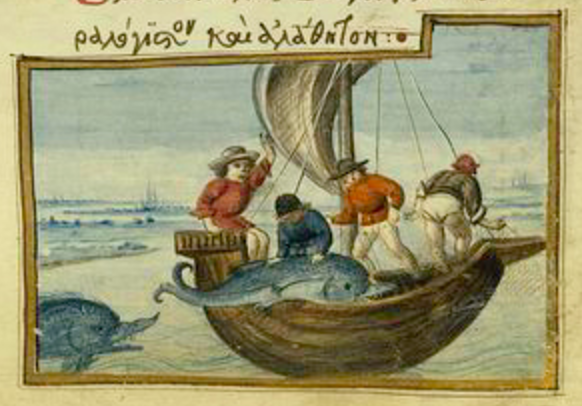
Fishermen having gone to fish and tired with fishing a long while, besides oppressed with hunger and grief, because they had taken nothing, when they resolve to go away, behold, a certain fish flying from another pursuing him, leaps into the boat. THe fishermen very joyful take him and sell him in the city at a great price.
Moral. This fable shows that fortune offers that very frequently which art is not able to effect.


185. Of a Poor and Infirm Man
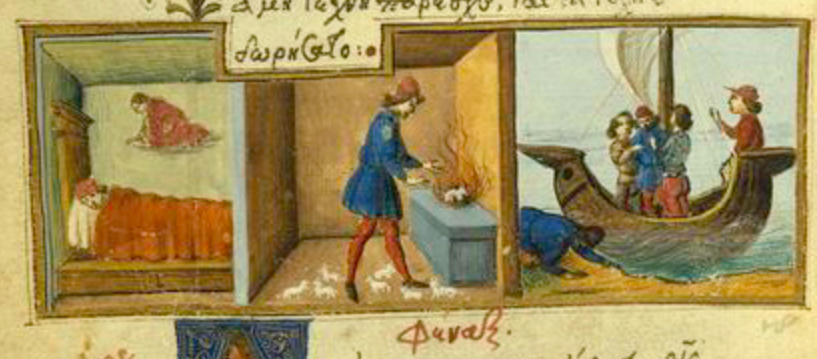
A certain poor man, when he was sick, vowed to the gods that if he should be freed from that disease, he would sacrifice a hundred oxen. Which the gods willing to try, easily restore health to him. Therefore free from the disase, when he had not the oxen because he was poor, he gathered the bones of a hundred oxen and, placing them upon the altar, he said, "Behold, now I pay the vow which I vowed to you." The gods, hearing this, stand before him in dreams and say, "Go to the shore of the sea, for there thou shalt find a hundred talents of gold in a secret place." He, having awoke, mindful of the dream, whilst he goes on to the shore, falls among thieves, who rob and beat him.
Moral. This fable shows that liars receive the rewards of lies.


Sunday, November 5, 2023

Clarke: English (36)

Here are some more fables from H. Clarke's Latin textbook Fabulae Aesopi selectae, or, Select fables of Aesop, and you can click here for all the fables reposted from this book at the blog.


176. Of the Son of a Certain Old Man and a Lion
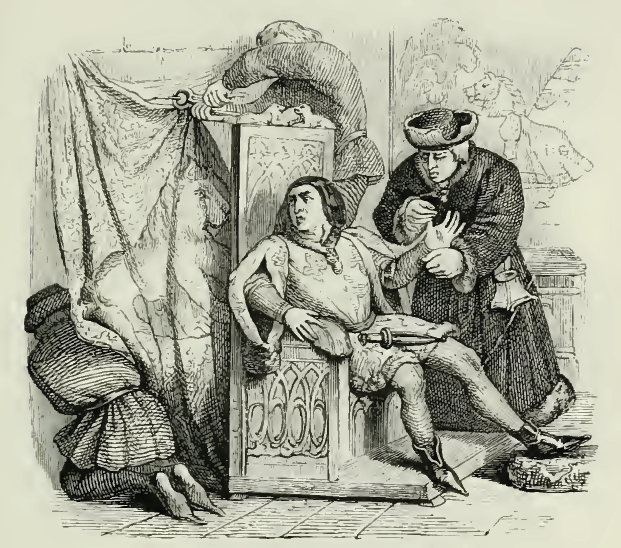
A certain elderly man had an only son of a generous spirit, and a lover of hunting-dogs. He had seen him in a dream to be killed by a lion. Therefore afraid, lest by chance sometime the event should follow this dream, he built a certain very fine and very pleasant house, bringing his son thither, a daily guardian was present to him. He had painted in the house every kind of animals for the delight of his son, with which also a lion. The youth looking on these things contracted trouble by so much the more. But on a certain time, standing nearer to the lion, he said, "O most cruel wild beast, I am kept up in this house for a vain dream of my father: what shall I do to thee?" And so saying, he struck his hand on the wall, willing to pluck out the eye of the lion, and he hit it on a nail, which lay hid there, with which blow the hand rankled, and corruption grew beneath, and a fever followed, and in a short time he died. Thus the lion killed the youth, art of the father availing nothing.
Moral. This fable shows that no man is able to avoid those things which are to come.


177. Of a Fox and a Bramble
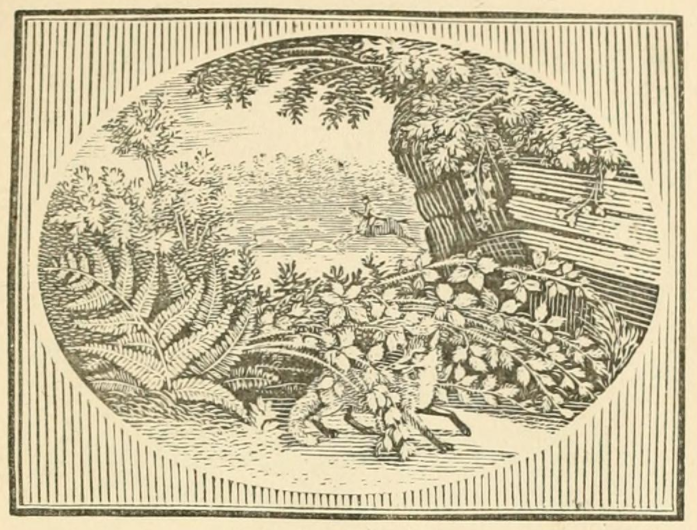
A fox, when she was ascending a certain hedge that she might avoid a danger which she saw to hang over her, caught hold of a bramble with her paws, and pricked the hollow of her paw with the thorns, and when she was wounded grievously, she said, groaning, to the bramble, "When I had fled to thee that thou mightest have helped me, thou hast hurt me." To whom the bramble says, "O fox, thou hast erred who hast thought to take me with the like deceit with which thou hast used to take other things."
Moral. The fable signifies that it is a foolish thing to implore help from them to whom it is given by nature rather to hurt than to profit.


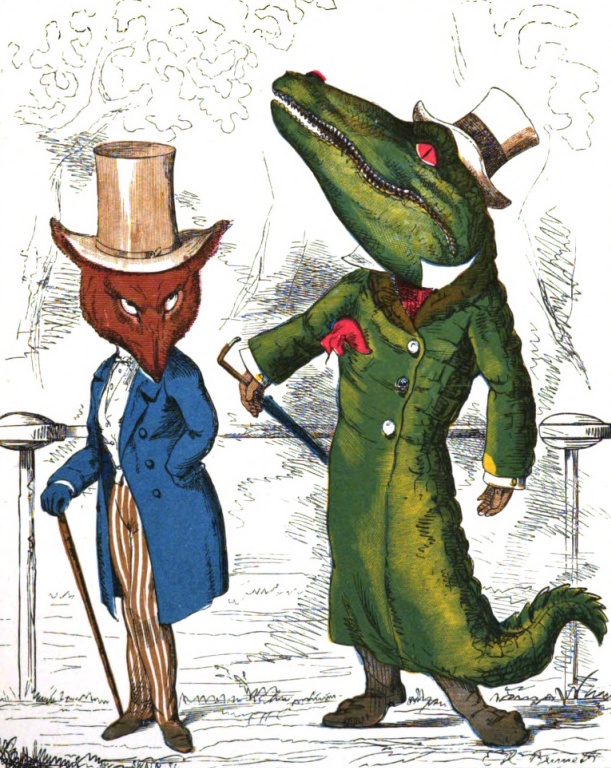
178. Of a Fox and a Crocodile
A fox and a crocodile contended concerning their nobility. When the crocodile adduced many things for himself and boasted himself beyond measure concerning the splendor of his ancestors; the fox smiling, said to him, "So ho, friend, although indeed thou hadst not said this, it appears clearly by thy skin that now many years thou hast been deprived of the splendor of thy ancestors."
Moral. The fable signifies that the thing itself chiefly refutes lying men.


179. Of a Fox and Huntsmen
A fox, flying from huntsmen and now tired with running along the way, by chance found a woodcutter whom he asks that he may hide himself in any place. He showed the cottage; the fox entering it hides himself in a certain corner. The huntsmen come up, ask the woodcutter if he saw the fox. The woodcutter denies in words indeed that he had seen him, but he showed the place with his hand, where the fox lay hid, but the huntsmen, the thing not being perceived, immediately go away. The fox, as soon as he perceives them to be gone away, coming out of the cottage, retires silently. The woodcutter accuses the fox that when he had made him safe, he gave no thanks to him. Then the fox, turning himself says softly to him, "Hark ye, friend, if thou hadst had the works of thy hands, and thy morals like to thy words, I would pay the deserved thanks to thee."
Morale. The fable signifies that a wicked man, although eh promises good things, yet he performeth bad and wicked things.


180. Of a Dog Invited to Supper
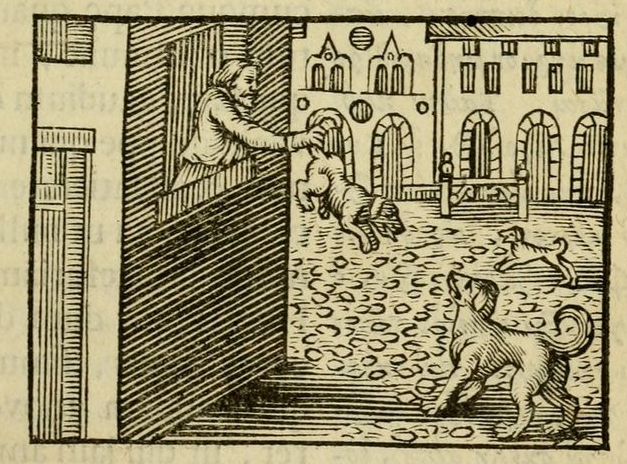
A certain man, when he had prepared a dainty supper, invited a certain friend home; his dog also invited the dog of the other man to supper. The dog, having entered, when he saw so great dainties prepared, joyful, says with himself, "Truly I shall fill myself today that I shall not want to eat tomorrow." But the cook, seeing him, silent took him by the tail and, whirling him three and four times, threw him through the window. He amazed rising up from the ground, whilst he flies crying, the other dogs run up to him and ask how daintily he had supped, but he, languishing, says, "I have filled myself so with drink and dainties that when I came out, I saw not the way."
Moral. The fable signifies that many things fall between the cup and the lips.