Today's story is inspired by a traditional Aesop's fable, number 82 in the Perry corpus.
The Rooster, the Donkey and the Lion
The rooster and his friend the donkey went out into the field one day; the rooster perched upon the fence while the donkey was eating the grass, and there a lion saw them. The lion crept through the tall grass, stalking them, but before he could pounce, the rooster saw the lion and called out loudly to warn his friend of the danger. "Cock-a-doodle-doo! Cock-a-doodle-doo!" crowed the rooster. Now there is nothing a lion fears more than the sound of the rooster's crow, so he turned tail and ran. The foolish donkey laughed and said, "Look at that lion, scared of a rooster!" Then he decided to chase the lion, taunting him as he ran. "You big baby! You coward! Run away! Run away!" Meanwhile, the rooster kept crowing — "Cock-a-doodle-doo! Cock-a-doodle-doo!" — but as soon as the rooster was out of earshot, the lion turned around and attacked the donkey, dragging him to the ground. "I may be afraid of the rooster crowing," he snarled, "but I am not afraid of you. Donkeys are supposed to run away from lions, not after them, you fool!" And then the lion killed the donkey and ate him.
This fable depends on an ancient Greek folk belief about the lion being afraid of the rooster's crow, a belief which also appears in the fable about the lion and the elephant (Perry 259). Especially since I just wrote about a lion who was afraid of the sound made by a frog (The Lion and the Frog), I decided to put the focus on the lion here, having him pronounce the endomythium, where the lion has the good sense to admit his own weakness, shameful though it might be, while rebuking the donkey for not having that same self-awareness of his strengths and weaknesses.
In the ancient Greek version of the story, there is no endomythium at all, and that is true for many of the English versions also, including the widely reprinted version in Croxall: An Ass and a Cock lived in a farmyard together. One day a hungry Lion passing by and seeing the Ass in good condition, resolved to make a meal of him. Now, they say that there is nothing a Lion hates so much as the crowing of a Cock; and at that moment the Cook happening to crow, the Lion straightway made off with all haste from the spot. The Ass, mightily amused to think that a Lion should be frightened at a bird, plucked up courage and galloped after him, delighted with the notion of driving the king of beasts before him. He had, however, gone no great distance, when the Lion turned sharply round upon him, and made an end of him in a trice. Presumption begins in ignorance and ends in ruin.
In some versions, the donkey supposedly follows the lion because he thought he was the cause of the lion running away, not recognizing it was the rooster, but I liked the way Croxall put it, with the donkey laughing at a lion being afraid of a bird, so I went with that approach, and had the donkey taunt the lion as he ran. But the idea of the donkey mistakenly thinking that his own bray is powerful is a very nice approach also, and that is what makes the tiny limerick by Linton work so well:
The Ass gave a horrible bray,
Cock crowed; Lion scampered away;
Ass judged he was scared
By the bray, and so dared
To pursue; Lion ate him they say.
DON'T TAKE ALL THE CREDIT TO YOURSELF.
If I were to include this fable in a cycle about foolish donkeys I would definitely go with that version about the donkey and the power of his bray, but instead I was more interested in emphasizing the donkey's contempt for the lion's shameful fear and the lion's contempt for the donkey's reckless courage. The donkey's contempt for the lion is emphasized in the version that appears in Caldecott's Aesop:
An Ass and a Cock were in a shed. A hungry Lion caught sight of the Ass and was on the point of entering the shed to devour him. But he took fright at the sound of the Cock crowing, for people say that Lions are afraid at the voice of a Cock, and turned away and ran. The Ass, roused to a lofty contempt of him for being afraid of a Cock, went out to pursue him, but when they were some distance away, the Lion ate him up.
As an alternative to the donkey's contempt for the lion, I also like the idea of the donkey's false courage and "cowards who thus provoke their fate" in this nice verse version in an anonymous 19th-century children's Aesop:
An Ass and Cock together fed,
When, startled by a Lion's tread,
With clarion shrill, bold chanticleer
Scared him away in panic fear.
The Ass, courageous at the sight,
Pursued the Lion in his flight,
But found too far his courage bore him,
For round the monarch turned and tore him.
Cowards who thus provoke their fate,
Like the poor Ass may find, too late,
That courage false leads on to danger,
When on them turns the bold avenger.
LOOK BEFORE YOU LEAP.
DISCRETION IS THE BETTER PART OF VALOR.
In the English versions I found with an endomythium, it was always pronounced by the donkey rather than the lion. For example, here is Dugard's version in verse; this endomythium gave me the idea to juxtapose wisely running away from a lion as opposed to foolishly running after him:
The Cock and Ass together feed,
Towards whom a Lyon making speed,
The Cock first sees him, and to warn
The Ass to shun ensuing Harm
He crows aloud, at whose shrill Voice
the Lion back retires (no Noise
More terrifying him than that)
Which when the Ass perceived, thereat
Insults, and thinks from him he flew,
Seeming with Fury to pursue
The Lyon. But ere far they had gone,
Beyond the Noise of Cocks, where none
Was present but the Ass, and he,
The Lyon longer scorns to flee,
But turns, and unresisted slew
The Ass that did but now pursue,
Who thus laments, "Alas, that I,
Of cowardly Parents born, must die,
Not able, in this fatal Strife,
Return a Stroke to save my Life,
Nor when in Safety feeding, fly,
But follow such an Enemy."
Ayres' prose version also features an endomythium by the donkey: The Cock and the Ass feeding together, a Lion came to seize the Ass, which the Cock perceiving, crowed aloud to give him notice of it, at which shrill noise, the Lion being affrighted ran away, for so 'tis said the Lion alwaies dreads a Cock's Voice. But the Ass thinking he had fled for fear of him, pursued the Lion, who ran very far, till looking back, and not hearing nor seeing the Cock, turned furiously upon the Ass, and devoured him. The Ass crying with a lamenta∣ble voice, as he was dying, O Fool and Unfor∣tunate! that knowing my self not to be of a Valiant and Couragious Race, should thus madly engage against so powerful an Enemy." Many men out of design, counterfeit Fear till they find an opportunity to fall upon their Ene∣mies and destroy them.
Notice that hint in Ayers' epimythium that the lion was just pretending to be afraid in order to lure the donkey into a trap! I don't think that really fits with the idea of the fable, but it just goes to show how different people can twist and turn the details of the plot in order to promote the message they want to convey.
I can also imagine a version where the rooster would fly up and pronounce an endomythium over the donkey's body. Some versions emphasize the idea of the rooster being a friend to the donkey and trying to warn him (which is something I included in my version too), so the rooster's endomythium could be along the lines of "I tried to warn you, my friend, but instead I provoked you to run to your own death" or something like that.
To be honest, when I started to work on this fable today, I wasn't sure if it would turn out to be interesting or not; I chose it because it is one of the donkey fables in the Nahuatl Aesop that Hector Tapia is working on. I was really pleased and surprised to find out how many fascinating little differences there were among the English versions that I looked at. That actually made it hard, but fun, to write my own version since I had to make my own choices out of so many good possibilities.
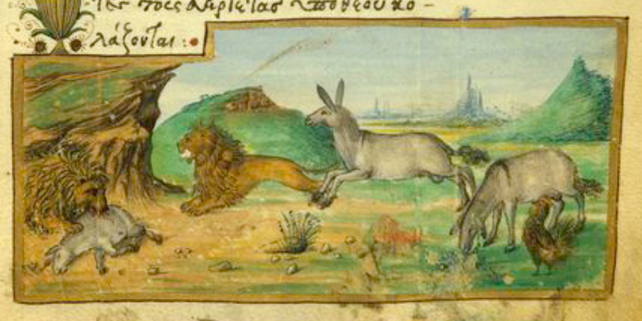
For an illustration, the
Medici Aesop is wonderful, showing the stages of the plot from right to left: the donkey and the rooster feeding, the donkey chasing the lion, and then the lion turning on the donkey and killing him.
Click here for
more illustrations and English versions of this fable, and for more "favorite fables" at this blog, see
the Aesopica label. You can find out more about this retelling project, see this post:
Favorite Aesop's Fables.