Sunday, September 17, 2023

Clarke: English (16)

Here are some more fables from H. Clarke's Latin textbook Fabulae Aesopi selectae, or, Select fables of Aesop, and you can click here for all the fables reposted from this book at the blog.


76. Of the Satyr and the Traveler
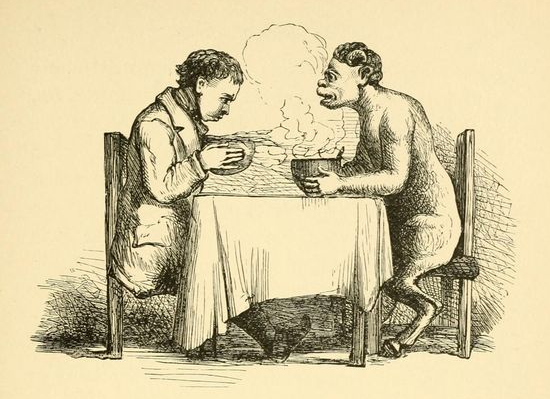
A satyr, who formerly was accounted a god of the woods, having pitied a traveler covered with snow and almost dead with cold, leads him into his cave, cherishes him with fire. But whilst he breathes into his hands, he inquires the cause, who, answering, says, "That they may be warm." Afterwards, when they sat down, the traveler blows into his porridge, which being asked why he did, he said, "That it may grow cool." Then immediately the satyr, casting out the traveler, says, "I am not willing that he be in my cave who has so different a mouth."
Moral. Avoid a double-tongued man who is a Proteus in discourse.


77. Of the Bull and the Mouse
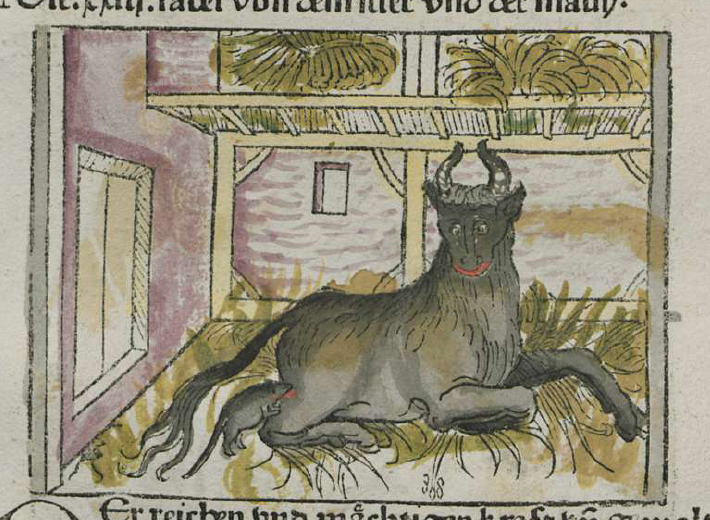
The mouse had bit the foot of the bull, flying into his hole. The bull brandishes his horns, seeks his enemy, sees him nowhere. The mouse laughs at him; says he, "Because thou art robust and big, therefore you should not have despised anyone. Now a little mouse has hurt thee, and indeed gratis."
Moral. Let no man rate his enemy at a lock of wool.


78. Of the Countryman and Hercules
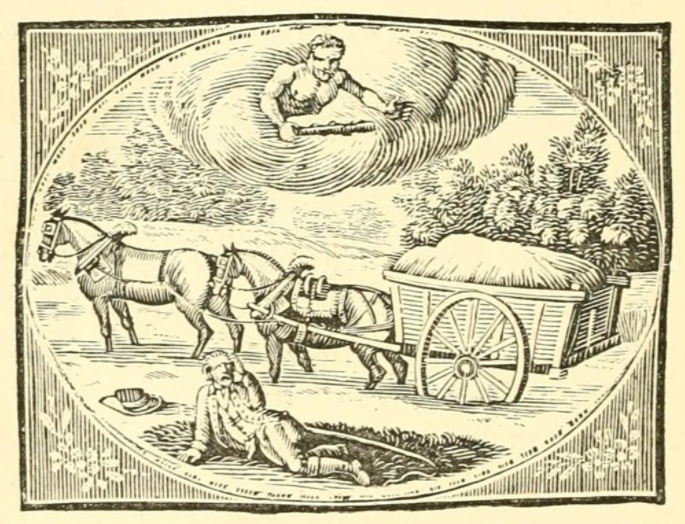
The wagon of a countryman sticks in deep clay. By and by laying along, he implores the god Hercules. A voice thunders out of heaven, "Fool, whip thy horses, and thyself try at the wheels, and then Hercules, being called, will be present."
Moral. Idle vows profit nothing, which indeed God does not hear. Thyself help thyself; then God will help thee.


79. Of the Grasshopper and the Pismire
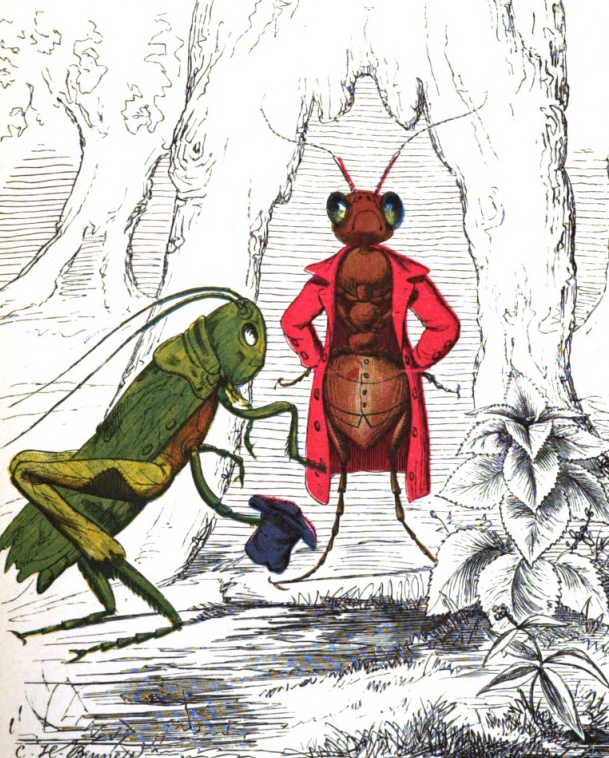
When the grasshopper sings in the summer, the ant exercises her harvest, drawing the grains into a hole which she lays up against winter. The winter raging, the famished grasshopper comes to the ant and begs victuals. The ant refuses, saying that she had labored whilst she sang.
Moral. Who is slothful in youth shall want in old age, and who doth not spare, by and by shall beg.


80. Of the Dog and the Lion
A dog, joking, meets a lion, "Why dost thou, exhausted with want, run through the woods and byplaces? See me, fat and sleek, and I obtain these things not by labor, but by idleness. Then the lion says, "Thou indeed hast thy dainties but, fool, thou hast also chains. Be thou a slave, who art able to serve; I, indeed, am free, nor am I willing to serve."
Moral. The lion answered beautifully, for liberty is better than all things.

[this fable is usually told about a wolf, not a lion,
so I don't have an illustration]
Babrius (9)

Here are some more fables by Babrius, translated into English verse by James Davies: The Fables of Babrius, and you can click here for all the Babrius fables at this blog.


The Wolf and the Nurse
A country nurse, to fright her babe to peace,
Said, "Wolf shall have thee, or thy cries must cease."
The wolf o'erheard, believed the scolding crone,
And stay'd in hopes to find the feast his own.
But evening came; the babe was hush'd to rest;
The wolf still gaped, with rav'ning hunger prest.
At last his hopes to utter dulness grew;
Then to his anxious helpmate he withdrew.
"How cam'st thou empty?" said she. He replied,
"Because upon a female I relied."


The Flea and the Ox
Once of an ox a flea this question ask'd:
"Why do you bear by mortals to be task'd,
And daily toil for them, since surely you
Are a courageous brute, a fine one too?
Whereas I bite their flesh, though small to see,
And fearless drink their red blood greedily."
The ox replied, "To men I know my debt.
From them I ever care and kindness met.
My forehead and my shoulders oft they stroke,
And scratch and rub me, pleasure to provoke."
To the strong ox the flea then answer made,
"Ah! but to luckless me this rubbing trade,
You talk of, would result in death outright,
Whene'er upon me men's nails chanced to light."
We ever love the hand that doth us good.
But requite hurt with hurt, in vengeful mood.


The Heifer and the Bull
A heifer yet unbroken, roaming free,
A bull hard-work'd in ploughing chanced to see;
And said, "Poor wretch, how grievous is thy toil!"
Nought said the bull, but still upturn'd the soil.
Soon, when the rustics held their solemn feast,
The aged bull to pasture went released;
But ropes that bound its horns the heifer drew,
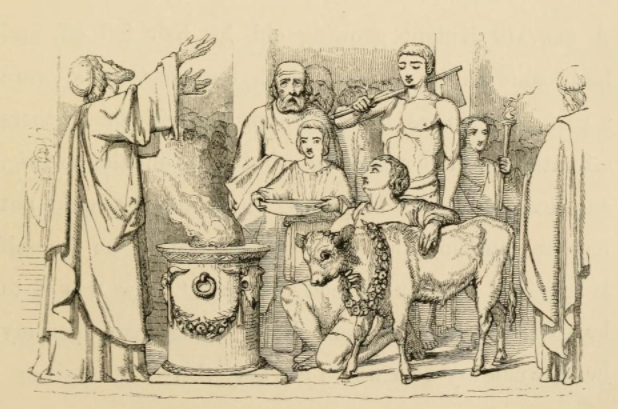
That it with blood the altar might bedew.
To whom this sentence then the elder spoke:
"'Twas for this end they kept thee from the yoke.
Young before old, thou dost the altar deck;
The axe, and not the yoke, will bruise thy neck."


The Dragon and the Eagle
A dragon and an eagle fiercely met,
Contending, which should which as captive get.
The dragon got the eagle 'neath his yoke,
And bound him fast, so as almost to choke.
A farmer saw, and loosed the dragon-chain,
And bade the eagle roam at large again.
At this the dragon deep resentment bore,
And in the farmer's cup did venom pour.
So when he was about to lift it up,
Not knowing its contents, and drain the cup,
On this the eagle pounced with flapping wings,
And from the farmer's grasp the vessel flings.
Thus him that saved him did the eagle save,
Thus to his champion grateful succour gave.


The Fir-Tree and the Bramble
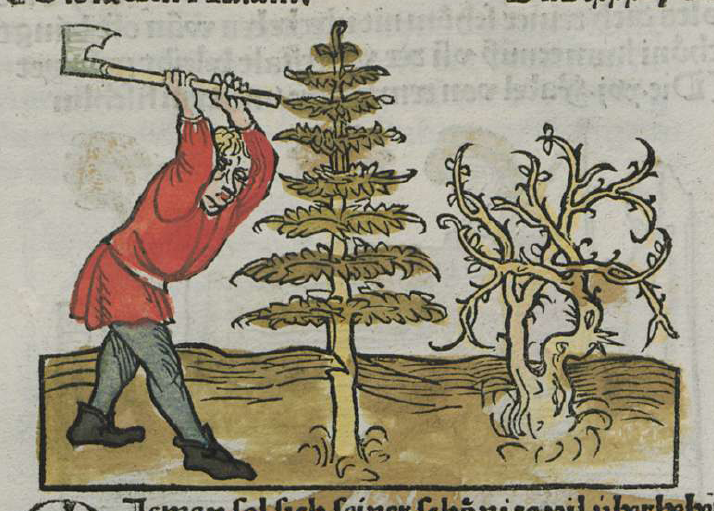
A fir-tree and a bramble disagreed,
For the fir alway paid to self the meed
Of praise. "I'm fine, well-grown in point of size,
And my straight top is neighbour to the skies.
'Tis I, am roof of mansions, keel of ships:
So much my comeliness all trees outstrips."
To whom the bramble said, "Keep well in view
The axe, whose business is thy trunk to hew,
And saws, that cut thee: haply thou'lt prefer
To be the bramble, rather than the fir."
All men of mark more rank and credit gain
Than meaner folks, but still more risks sustain.


Saturday, September 16, 2023

Clarke: English (15)

Here are some more fables from H. Clarke's Latin textbook Fabulae Aesopi selectae, or, Select fables of Aesop, and you can click here for all the fables reposted from this book at the blog.


71. Of the Peacock and the Crane
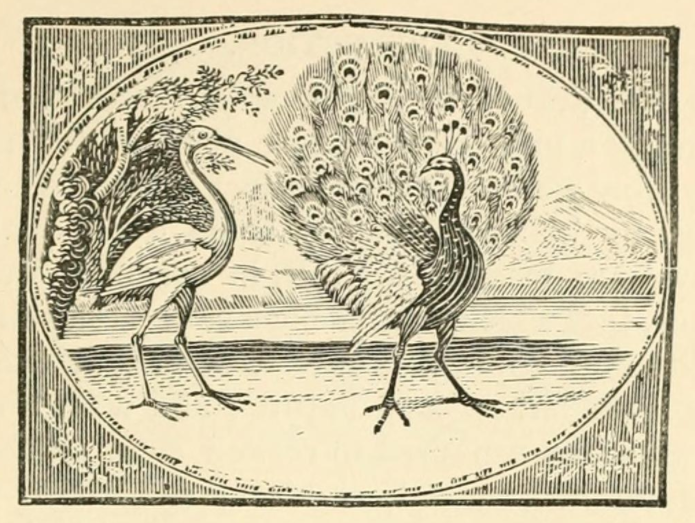
The peacock and the crane sup together. The peacock boasts himself, shows his tail; the crane confesses the peacock to be of most beautiful feathers, yet that he pierced the clouds with a bold flight, whilst the peacock scarcely flies over the houses. 
Moral. No man should despise another: there is to every one his own portion; there is to every one his own virtue. He who wanteth thy virtue perhaps may have that which thou mayest want.


72. Of the Oak and the Reed
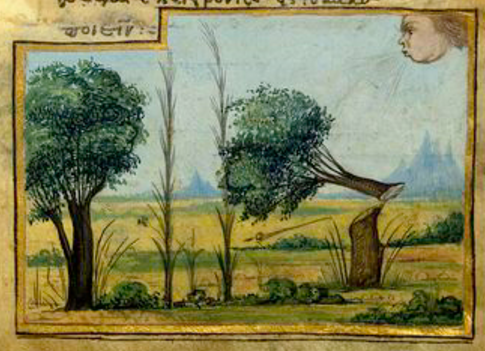
The oak, being broken by the stronger south wind, is thrown into the river, and, whilst she flows, by chance sticks by her boughs upon a reed. She wonders that a reed stood safe in so great a whirlwind. She answers that she was safe by her flexibility; that she yielded to Notus, to Boreas, to every blast, nor was it a wonder that the oak should fall, who desired not to yield but to resist.
Moral. Do not resist one more powerful, but overcome him by yielding and bearing.


73. Of the Lion and the Hunter
The lion contends with the hunter; he prefers his strength to the strength of man. After long disputes, the hunter leads the lion to a tomb on which a lion was carved laying down his head on the lap of a man. The beast denies that to be enough proof, for, he says, that men carved what they would, but if lions were artificers, that the man now would be carved under the feet of the lion.
Moral. Every one, as much as he is able, both says and does that which he thinks to be profitable to his cause and party.


74. Of the Boy and the Thief
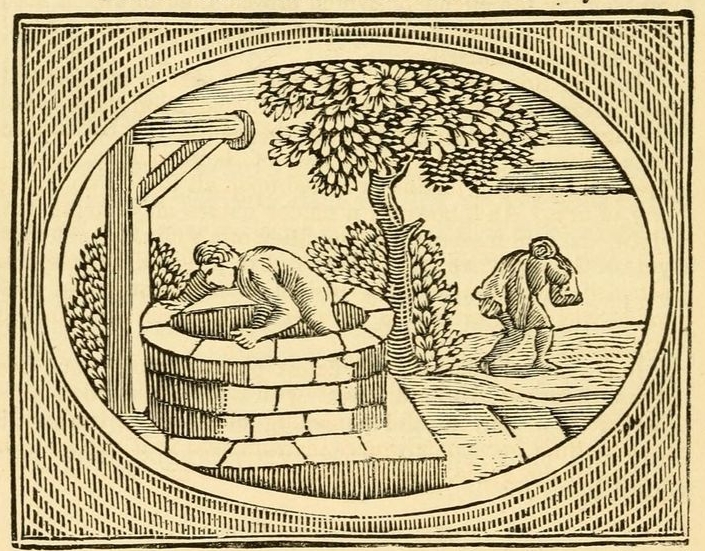
A boy sat weeping at a well. A thief asks the cause of his weeping; the boy says, the rope being broken, that an urn of gold had fallen into the waters. The man undresses himself, leaps into the well, seeks for it. The vessel not being found, he comes up, and there neither does he find the boy nor his own coat, for the boy, the coat being taken away, had fled.
Moral. Sometimes they are deceived who are wont to deceive.


75. Of the Countryman and the Steer
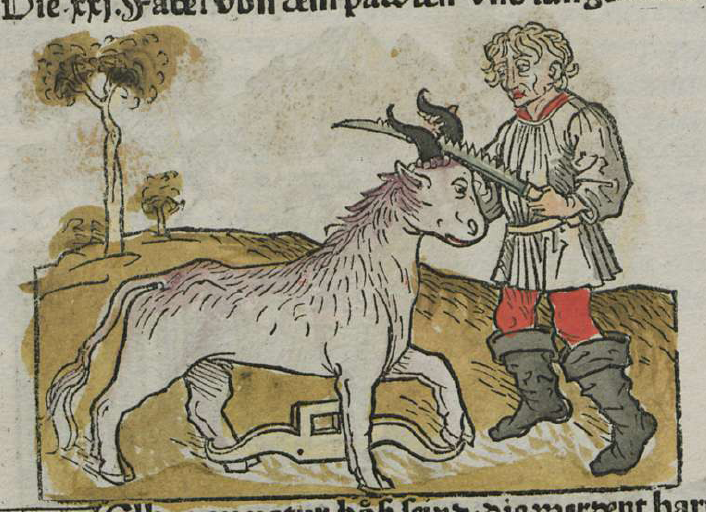
A countryman had a steer impatient of every chain and yoke. The man, a little cunning, cuts off the horns of the beast, for he struck with his horns. Then he joins him not to the cart but to the plough, that he should not strike his master with his heels, as he was wont. He holds the plough, rejoicing that he had effected by industry that now he should be safe both from horns and from hoofs. But what happened? The bullock frequently resisting by scattering the sand fills the mouth and head of the countryman with it.
Moral. Some are so intractable that they cannot be managed by any art or counsel.