Thursday, August 17, 2023

Clarke: English (7)

Here are some more fables from H. Clarke's Latin textbook Fabulae Aesopi selectae, or, Select fables of Aesop, and you can click here for all the fables reposted from this book at the blog. 


31. Of the Members and the Belly
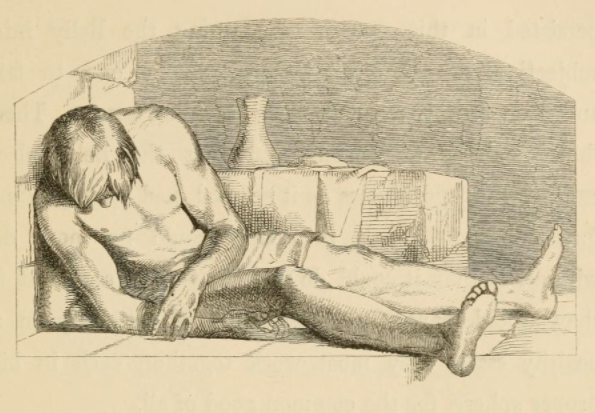
Formerly the feet and hands accused the belly that the gains of them were devoured by him being idle. They command either let him labour or not think to be maintained. He entreats once and again, yet the hands deny sustenance; the belly being exhausted with want, when all the limbs began to fail, then at last the hands were willing to be officious, but that too late: for the belly, weak by disuse, refused meat. Thus all the limbs, whilst they envy the belly, perish with the perishing belly.
Moral. The society of the members does not differ from human society. A member wants a member, a friend a friend; wherefore let us use mutual offices, mutual works; for neither riches, nor dignities defend a man enough. The only and chief safeguard is the friendship of many.

32. Of the Ape and the Fox
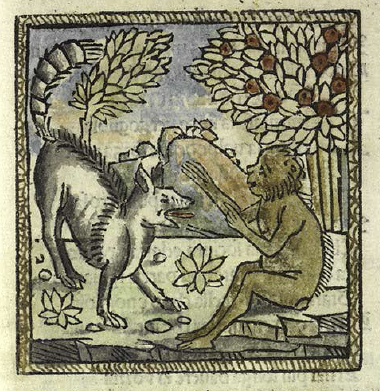
The ape prays the fox that she would give part of her tail to her to cover her buttocks, for that was a burden to her, which would be an use and honour to her. She answers that it was nothing too much, and that she had rather that the ground should be brushed with her tail than that the buttocks of the ape be covered.
Moral. There are who want; there are to whom there is over much; yet that is of a custom to no one of the rich that he bless the needy with his superfluous store.


33. Of the Fox and the Weasel
The fox, slender by long want, by chance crept through a narrow chink into a heap of corn, in which, when she was well fed, then her belly, being stretched, hindered her trying to go out again. A weasel afar off having seen her striving, at length advises, if she desires to go out, she would return to the hole lean, at which she had entered lean.
Moral. You may see many merry and cheerful in mediocrity, void of cares, free from troubles of mind. But if they shall be made rich, you shall see them go sad; never to smooth their forehead, full of cares, overwhelmed with troubles of mind.


34. Of the Horse and the Stag
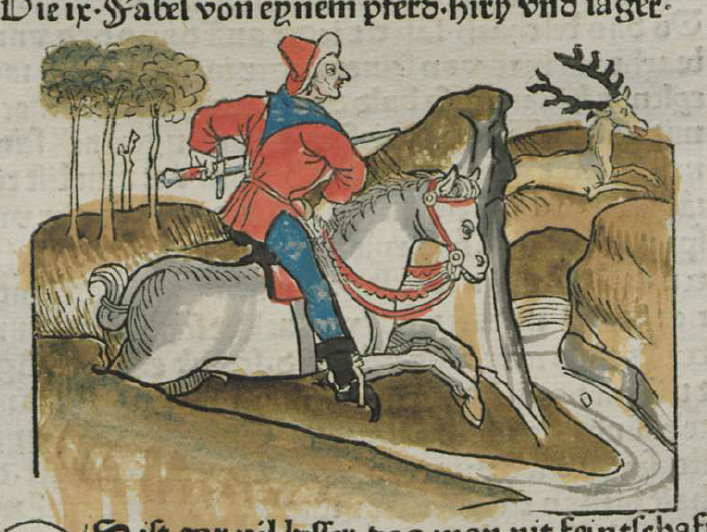
The horse carried on war with the stag; at length, being driven out of the pastures, he implored human help. He returns with a man, he descends into the field, he, conquered before, now becomes conqueror; but yet the enemy being conquered and sent under the yoke, it is necessary that the victor himself serve the man. He bears the horseman on his back, the bridle in his mouth.
Moral. Many fight against poverty which, being overcome by industry and fortune, the liberty of the victor often perisheth; for the lords and conquerors of poverty begin to serve riches; they are tormented with the whips of avarice, they are restrained with the bridles of parsimony; nor do they hold a mean of getting, nor do they dare to use the things got, a just punishment indeed of covetousness.


35. Of Two Young Men
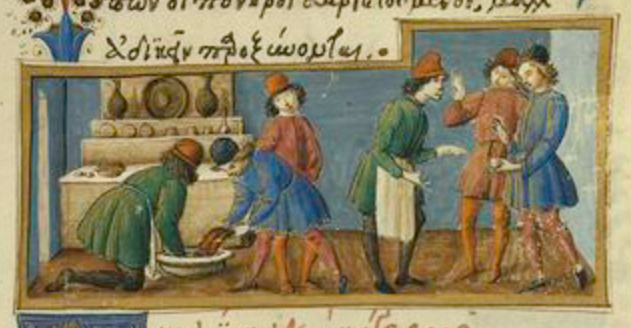
Two young men pretend that they would buy flesh at a cook's: the cook doing other things, one snatches flesh out of a basket, gives it to his companion that he may hide it under his garment. The cook, as soon as he saw part of the flesh stolen from him, began to accuse each of theft. He that had taken it away swears by Jove that he has nothing, but he who had it swears again and again that he had taken away nothing. To whom the cook says, "Indeed now the thief lies hid, but he, by whom you have sworn, looked on, he knows.
Moral. When we have sinned, men do not know it presently, but God sees all things, who sitteth upon the heavens and looks into the deeps.

Wednesday, August 16, 2023

Clarke: English (6)

Here are some more fables from H. Clarke's Latin textbook Fabulae Aesopi selectae, or, Select fables of Aesop, and you can click here for all the fables reposted from this book at the blog. I plan to do a LibriVox recording of this book, so I will be transcribing all the fables here, and later I will be able to embed the LibriVox audio.


26. Of the Wood and the Countryman
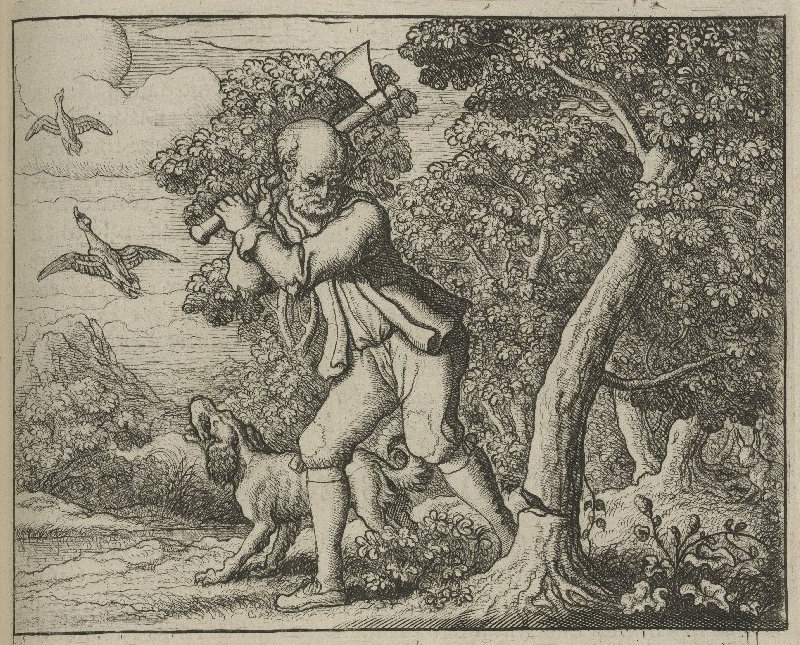
At what time there was speech even to trees, a countryman came into a wood, asks that it may be lawful to take a handle to his axe. The wood consents. The countryman, the axe being fitted, began to cut down the trees. Then, and indeed too late, it repented the wood of her easiness; it grieved her to be herself the cause of her own destruction.
Moral. See of whom thou mayest deserve well: there have been many who have abused a benefit received to the destruction of the author.


27. Of the Wolf and the Fox
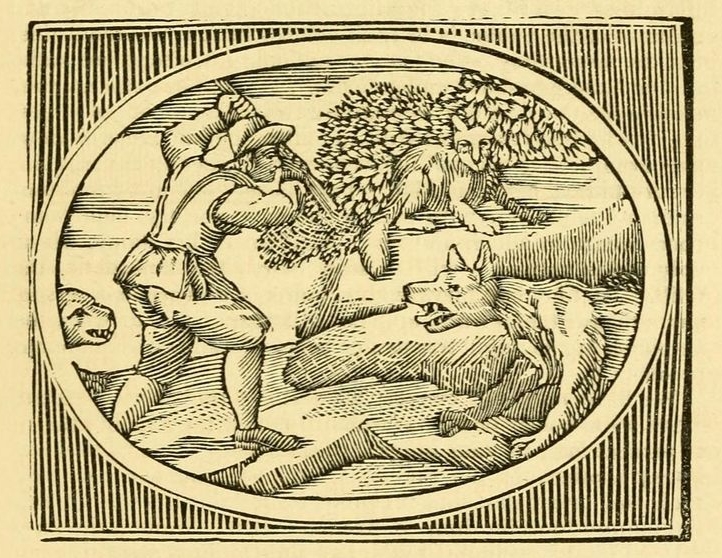
The wolf, when there was enough of prey, lived in idlenes. The fox comes to him, demands the cause of his idleness. The wolf perceived there were treacheries, pretends a disease to be the cause, prays the fox to go to pray the Gods. She, grieving that the trick did not succeed, goes to the shepherd, advises him that the den of the wolf lay open, and the enemy being secure could be destroyed unawares. The shepherd rises upon the wolf, slays him. The fox obtains the den and the prey, but short was the joy of her villainy to her; for a little after, the same shepherd takes her.
Moral. Envy is a foul thing, and sometimes pernicious also to the author himself.


28. Of the Viper and the File
A viper, finding a file in a smith's shop, began to gnaw it; the file smiled, saying, "Fool, what dost thou do? Thou wilt have worn out thy teeth before thou wearest out me, who am wont to gnaw off the hardness of brass."
Moral. See again and again with whom thou hast an affair; if thou whettest thy tooth against a stronger man, thou wilt not hurt him, but thyself.


29. Of the Stag
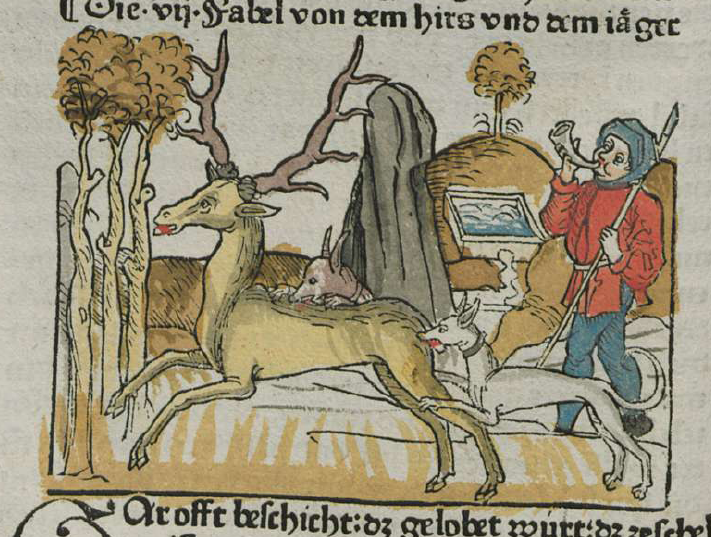
A stag, having beheld himself in a clear fountain, approves his lofty and branched horns but condemns the smallness of his legs. By chance, whilst he looks, whilst he judges, the huntsman passes by: the stag flies away. The dogs pursue him flying, but when he had entered a thick wood, his horns were entangled in the boughs. Then at last he praised his legs and condemned his horns, which made that he was a prey to the dogs.
Moral. We desire things to be shunned, we fly things to be desired. What hurt, please; what profit, displease. We desire happiness, before that we understandmwhere it is; we seek the excellency of riches, and the loftiness of honours; we think happiness placed in these, in which there is so much of labour and pain.


30. Of the Wolves and the Lambs
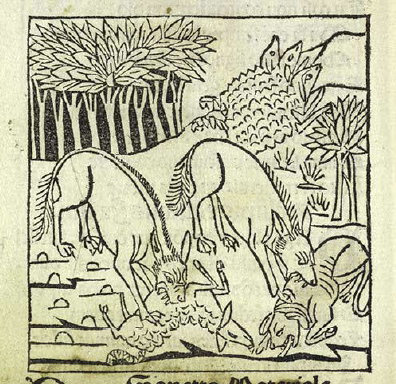
On a time there was a league between the wolves and the lambs, to whom there is a discord by nature. Hostages being given on both sides, the wolves gave their whelps, the sheep their troop of dogs. The sheep being quiet and feeding, the little wolves through desire of their dams send forth howlings: Then the wolves rushing on them cry out that their faith and league was broken, and butcher the sheep destitute of their guard of dogs.
Moral. It is folly if in a league thou deliverest thy guards to an enemy; for he who has been an enemy, perhaps not yet has ceased to be an enemy; and perhaps will take occasion why he may rise upon thee stript of thy guard.


Monday, August 14, 2023

Clarke: English (5)

Here are some more fables from H. Clarke's Latin textbook Fabulae Aesopi selectae, or, Select fables of Aesop, and you can click here for all the fables reposted from this book at the blog. I plan to do a LibriVox recording of this book, so I will be transcribing all the fables here, and later I will be able to embed the LibriVox audio.


21. Of the Wolf and the Painted Head
The wolf turns about and admires a human head found in the shop of a carver: perceiving it to have nothing of sense, he says, "O fair head, there is in thee much of art, but nothing of sense."
Moral. Outward beauty, if the inward be present, is pleasing; but if we must want either, it is better to want the outward than the inward; for that without this sometimes incurs hatred, as a fool is by so much the more odious by how much the more handsome.


22. Of the Jackdaw
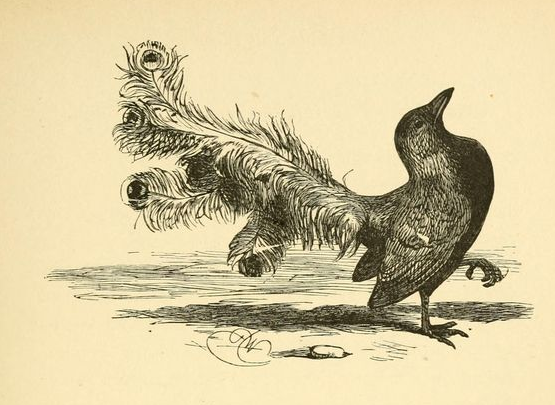
The jackdaw adorned himself with the feathers of the peacock: then seeming pretty to himself, he betook himself to the race of the peacocks, his own race being despised. They at length understanding the cheat, stripped the foolish bird of his colors, and belavored him with blows.
Moral. This fable denotes those who carry themselves more loftily than is fit; who live with those who are both more rich and more noble; wherefore often they become poor, and are for a laughing-stock.


23. Of the Frog and the Ox
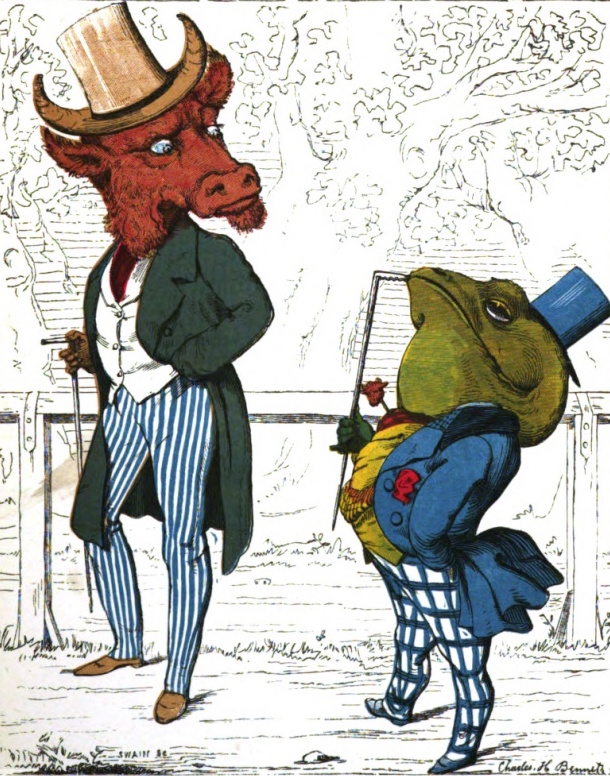
A frog desirous of equalling an ox stretched herself. The son advised the mother to desist from the undertaking, saying that a frog was nothing to an ox. She swelled a second time. The son cries out, "Mother, although you burst, never will you exceed the ox." But, when she had swelled a third time, she burst.
Moral. Every one has his gift. This man excels in beauty, that in stremgth. This is powerful in riches, that in friends. It becometh every one to be content with his own. He is strong in body; thou in wit: Wherefore let every one consult himself, nor envy a superior, which is a miserable thing; nor wish to contend, which is the part of folly.


24. Of the Horse and the Lion
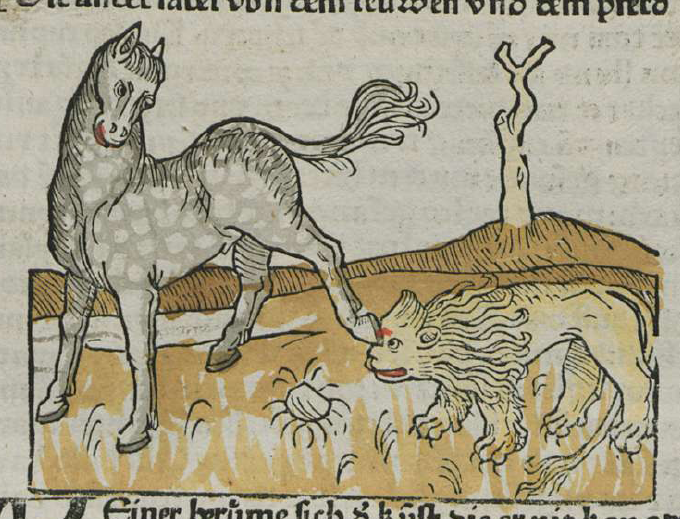
The lion cometh to eat the horse, but wanting strength thro' old age, he began to meditate art: he professes himself a physician: he stays the horse with a circuit of words. He opposes deceit to deceit: he feigns that he lately had pricked his foot in a thorny place; he prays that the physician looking into it would draw out the thorn. The lion obeys. But the horse, with how great force he could, strikes his heel upon the lion, and immediately betakes himself to his heels. The lion scarce at length returning to himself, for he had been almost dead with the blow, says, "I bear a reward for my folly, and he deservedly has fled away; for he has revenged deceit with deceit."
Moral. Dissimulation is worthy of hatred, and to be taken with dissimulation. An open enemy is not to be feared, but he who pretends benevolence, when he is an enemy, he indeed is to be feared and is most worthy of hatred.


25. Of the Birds and the Four-Footed Beasts
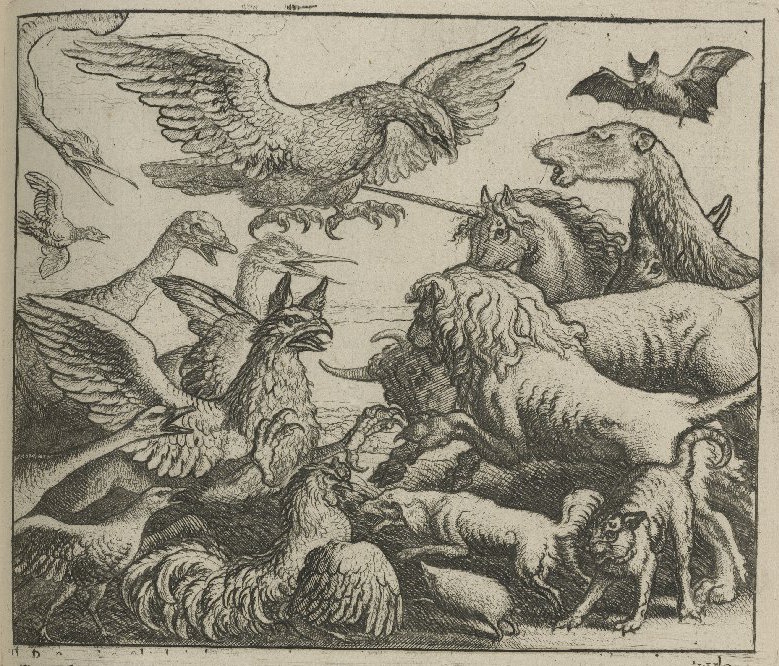
There was a battle to the birds with the four-footed beasts. There was on both sides hope, on both sides fear, on both sides danger: but the bat, leaving his companions, revolts to the enemies. The birds overcome, the eagle being captain and leader, but they condemn the runaway bat that he never return to the birds, that he never fly in the light. This is a reason for the bat that he flies not, unless in the night.